

The honest answer: JustDone’s AI detector works some of the time, and nobody — including JustDone — agrees on how often. The company itself publishes an 80% overall accuracy figure with a 10.3% error rate, while independent-ish tests in 2026 have landed everywhere from roughly 59% to the high 70s, with documented cases of the free detector flagging verified human writing as AI. That spread is the real story.
If you’re a student staring at a scary JustDone score, a teacher wondering whether to act on one, or a content editor choosing a detection tool, this review breaks down what JustDone AI actually is, what the competing accuracy numbers mean, who’s behind each test, and how to use the tool without getting burned by it.
What Is JustDone AI?
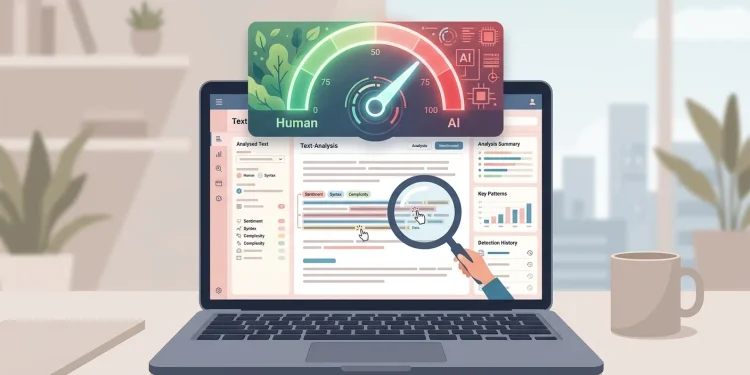
JustDone AI is a real, functioning writing platform, not a scam or a fly-by-night site. It bundles several tools under one subscription: an AI writer, a paraphraser, a plagiarism checker, an AI “humanizer,” and the AI detector this article focuses on. The detector scans pasted text and calculates a score indicating the likelihood that the content was created by artificial intelligence.
That bundle matters for one reason worth flagging early: JustDone sells both the detector and a humanizer designed to make AI text read as human. A company profiting from both sides of the detection game has a built-in tension, and it shows up later in this review.
What JustDone Claims About Its Own Accuracy
To its credit, JustDone is more restrained than many rivals. Its detector page currently states 80% overall detection accuracy across text types, 98% accuracy on academic and scientific texts, and a 10.3% error rate — published openly, with the note that no honest detector claims 100%. The company also says accuracy improves with longer texts and that short fragments, heavy formatting, and lists are the hardest cases for any detector.
Two caveats before taking those numbers at face value:
- They’re vendor-published benchmarks. JustDone’s own blog testing has at times cited even rosier figures, including near-100% accuracy on academic papers, which independent testing hasn’t reproduced.
- An 80% accuracy claim, read plainly, means the tool misses or mislabels roughly one in five texts even by its own math. For a tool used in academic-integrity situations, that’s not a small gap.
What Independent Tests Actually Found
Here’s where it gets messy — and where most reviews quietly mislead you, because almost everyone who tests JustDone has a horse in the race. The table below summarizes the main 2026-era results with each tester’s bias noted, which matters as much as the numbers.
| Who tested | Their bias | What they found |
|---|---|---|
| JustDone (vendor) | Selling the tool | 80% overall, 98% academic, 10.3% error rate |
| MPG One (marketing agency) | None disclosed | About 59–61% accuracy in a 2026 retest, down from roughly 70% earlier — the weakest of the three detectors it tested, behind Originality.ai (~88–90%) and GPTZero (~79–85%); no sample size given |
| GPTZero (competitor) | Sells a rival detector | Found the paid JustDone detector reported accurate scores for most AI and human samples, while the free version performed far worse; also found the detector scored JustDone’s own humanized AI text as 0% AI |
| Phrasly (competitor) | Sells a rival humanizer | Reported the free detector flagged verified human text as AI every time in its tests, including pre-2010 newspaper passages scored at 94%, 93%, and 73% AI |
| Skyline Academic (academic services) | Adjacent industry | Detector caught obvious AI samples but flagged human-written content as 97% AI in one test; verdict: useful but not fully reliable for academic decisions |
Strip out the agendas and a consistent picture still emerges from the overlap:
- It catches blatant, unedited AI text most of the time. Nearly every tester, friendly or hostile, confirms this.
- False positives on human writing are real and documented, especially on the free tier and shorter samples.
- The paid and free detectors behave like different products — more on that next.
- Nobody independent has replicated the 98% academic figure, and the only third-party test publishing an overall accuracy rate found one well below JustDone’s claim, though that test didn’t disclose its sample size either.
So “how accurate is it really?” lands somewhere between JustDone’s 80% and MPG One’s ~60%, varying with text length, editing, and which tier you’re using. That’s a wide, uncomfortable range — and it’s the truthful one.
The Free vs. Paid Detector Gap
One finding deserves its own section because it explains so many contradictory experiences online. Testing has shown the free and premium detectors function very differently: the same AI text that the free scan misjudged was flagged cleanly as 100% AI by the paid detector, and the premium tier avoided problems the free one showed.
The harsh reviews — human newspaper clippings scored 90%+ AI — came overwhelmingly from the free tool. The more forgiving assessments tested the paid one. If you’ve only used JustDone’s free scan, you haven’t really seen what the detector can do; you’ve seen a limited version that, intentionally or not, also functions as a funnel toward the subscription. Critics have called that structure a pay-to-fix upsell, a criticism echoed in press scrutiny of detector-plus-humanizer businesses.
Practical takeaway: never make any decision — academic, editorial, or otherwise — based on a free-tier JustDone score.
The Humanizer Problem
Now the conflict of interest. GPTZero’s testing found that after running AI text through JustDone’s own humanizer, JustDone’s detector scored the result 0% AI — raising the question of whether the detector simply isn’t trained, intentionally or not, to catch its own humanized output.
Read charitably, that’s a blind spot. Read cynically, it’s a product loop: the detector flags text, the humanizer “fixes” it, and the detector then blesses the fix. Either way, it means a clean JustDone score on humanized text proves very little, and other detectors (Turnitin, GPTZero, Originality.ai) may still flag what JustDone clears. Students who pay to humanize an essay and verify it only inside JustDone are getting false comfort.
Why Every AI Detector Struggles — Not Just This One
Some context keeps this review fair, because JustDone’s problems are partly the whole category’s problems.
AI detection is a statistical guess, not a fingerprint match. Detectors look for patterns — predictable word choices, uniform sentence rhythms — that AI text tends to show. But polished human writing can show the same patterns, which is why formal, carefully edited prose (including academic writing and old newspaper copy) triggers false positives across the industry. Research has also repeatedly shown detectors flag non-native English speakers’ writing at higher rates, since learned, careful English resembles machine output statistically.
Meanwhile the targets keep moving. Each new model generation writes more naturally, humanizers are built specifically to defeat detectors, and measured accuracy across the industry keeps sliding — the same arms race dragging every detector down, with JustDone, per the 2026 retest, losing ground faster than its rivals. Even OpenAI shut down its own AI-text classifier years ago over low accuracy. Any tool claiming near-perfect detection in 2026 is marketing, not measurement.
None of that excuses JustDone’s weaker-than-claimed results. It just means switching to a competitor buys you a better error rate, not certainty.
How to Use JustDone Sensibly (By Situation)
If you’re a student who got flagged: Don’t panic, and don’t treat the score as a verdict — JustDone’s own guidance says a flag is a starting point, not a conviction. Review which passages triggered it, gather your drafts, version history (Google Docs and Word both keep it), and notes. Those artifacts outweigh any detector percentage in an academic-integrity meeting.
If you’re a teacher or professor: At the accuracy levels independent tests report, a JustDone score is far too unreliable to be the sole basis for an accusation or penalty. Use it, at most, as one weak signal — then look for the evidence that actually holds up: draft history, a student’s writing voice across the semester, and a short conversation about the paper’s content.
If you’re an editor or content manager: Run suspect pieces through two or three detectors and compare. Agreement across tools means something; a lone JustDone flag means little. And weight long-form results over short ones — every tester, including JustDone, agrees short text is where accuracy collapses.
If you’re checking your own writing before submission: A high score on your genuinely human work is common enough that it shouldn’t scare you into rewriting your natural voice. If you must lower it, vary sentence length and add specific, personal detail — don’t pay to “humanize” text you actually wrote.
Verdict: Accurate Enough for Screening, Not for Judgment
JustDone AI’s detector sits in the middle of the pack at best. It reliably catches lazy, unedited AI output, the paid tier clearly outperforms the free one, and the company deserves some credit for publishing an error rate instead of a fantasy 99% claim. Against that: independent retesting places it last among major detectors, documented false positives on verifiably human text are hard to ignore, and the detector’s blindness to its own humanizer’s output undermines trust in clean scores.
Use it as a quick first-pass screen — ideally the paid version, ideally on longer texts, ideally alongside a second detector. Don’t use it, alone, to accuse anyone of anything, and don’t trust a 0% score on text that’s been through any humanizer. The tool is real; the certainty people want from it isn’t.
FAQ
Is JustDone AI legit or a scam?
It’s a legitimate, functioning company and platform. The “scam” chatter online mostly concerns the free detector’s false positives and the detector-plus-paid-humanizer business model, not fake billing or malware.
How accurate is the JustDone AI detector?
JustDone claims 80% overall and 98% on academic texts. The only independent test publishing a rate measured roughly 59–61% in 2026, and other hands-on reviews found the paid tier mostly accurate while the free tier misfired often. Treat any single score as an estimate, not proof.
Why did JustDone flag my human-written essay as AI?
False positives are a known issue, especially on formal or carefully edited writing, short samples, non-native English, and the free detector. Keep your drafts and version history as evidence of your process.
Is JustDone better than GPTZero or Turnitin?
In the one 2026 head-to-head retest, JustDone scored below both GPTZero and Originality.ai on clearly AI text. Results vary by content type, so serious use cases should cross-check with at least two tools.
Does a 0% JustDone score mean my text will pass other detectors?
No. JustDone’s detector scored its own humanizer’s output as 0% AI in testing, while other detectors flagged similar text. Each detector uses different models, so clearance in one predicts nothing about the others.