

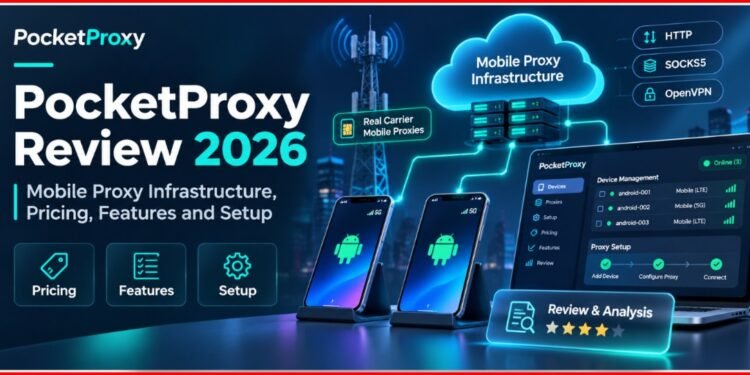
PocketProxy is not simply a conventional proxy storefront. Its central proposition is to help operators turn Android phones with active mobile-data SIMs into managed proxy endpoints. The operator supplies and controls the hardware and carrier connectivity; PocketProxy supplies the relay, tunnel, authentication, IP rotation, monitoring and customer-management infrastructure. The company also advertises a marketplace option for reselling ready-made proxies. This distinction matters: the recurring software fee is only one component of the total operating cost.
What PocketProxy offers
According to the official website, Android devices can be paired through an app and QR code without rooting or custom firmware. The platform presents device status, carrier, location, signal and connection information in a central console. Operators can create customer accounts, assign devices, manage permissions, set bandwidth caps and provide credentials. These features make PocketProxy particularly relevant to small mobile-proxy businesses and teams that want to manage their own cellular exit points without building the tunneling stack from scratch.
Core features
Real carrier egress: connections exit through the cellular data connection of the paired phone, rather than through a typical hosting-provider IP. The country and carrier therefore depend on the actual SIM and coverage, not merely on the selected relay region.
Multiple protocols: the site describes HTTP, SOCKS5 and OpenVPN support. The published plan comparison specifically lists OpenVPN under Business, so buyers should verify protocol entitlement for their chosen tier rather than assume all plans include every feature.
IP rotation: operators can trigger an IP change on demand, on a schedule or via a rotation link. PocketProxy says this uses an airplane-mode cycle and typically takes two to five seconds; whether a different public IP is assigned remains dependent on the mobile carrier.
Fleet and customer controls: a central dashboard offers device monitoring, customer assignments, permissions, traffic accounting and configurable usage caps. The vendor also advertises API access on its paid plans.
PocketProxy pricing in 2026
The official pricing page lists Basic at $4 per 30 days, Advanced at $7 per 30 days and Business at $8 per 30 days. Basic advertises 5 Mbit/s and three access points; Advanced, 25 Mbit/s and five access points; Business, 100 Mbit/s and 15 access points. Published log-retention periods are one, four and twelve weeks respectively. Business additionally lists OpenVPN, p0f and Traffic Split. These are advertised plan ceilings and features, not independently measured speeds.
There is also a 48-hour trial with one proxy and no credit card after email verification. PocketProxy states that it does not impose its own bandwidth quota; carrier data plans still impose their own conditions and costs. Before purchasing, confirm whether quoted charges apply to each connected phone, how tax is handled and whether optional services incur extra fees.
How to set up a mobile proxy
Step 1 — Prepare an Android phone with a functioning mobile-data SIM, adequate signal and stable power. PocketProxy lists Android 8.0 or newer on its pricing FAQ. Check that your carrier permits the intended usage.
Step 2 — Register on PocketProxy and select the relevant relay region. A relay is part of the routing infrastructure and does not automatically determine the exit-IP country.
Step 3 — Install the PocketProxy app on the phone and pair it using the QR code provided by the dashboard. Confirm the phone is online and showing the expected carrier.
Step 4 — Choose an available protocol and copy the assigned endpoint, port and authentication details. For an ordinary browser profile, HTTP is often the simplest starting point.
Step 5 — Connect a permitted test client, visit an independent IP-check service and verify the observed IP, ASN, country and connectivity. Test the rotation control and record whether the public IP actually changes.
Step 6 — If reselling, create a customer account, assign only the intended device and permissions, set a suitable usage cap and test customer access before handing over credentials.
Practical use cases
Localization and ad verification: teams can inspect how a site or campaign appears from a mobile carrier in a specific market, provided they actually have a phone and SIM in that market.
Application QA: developers can test network-dependent behavior, mobile routing and regional content from real cellular connections.
SEO and public-data monitoring: teams may use approved, rate-limited requests to compare search or public-page experiences. They should comply with site terms, privacy law and applicable access restrictions.
Proxy resale: entrepreneurs can provision customer access to physical phones they own or legitimately operate, while PocketProxy handles much of the software infrastructure. This model requires customer support, acceptable-use controls and a sustainable carrier-data budget.
Strengths and trade-offs
The main strengths are low advertised software entry pricing, no-root Android onboarding, real carrier connectivity, multiple connection methods, rotation controls and a console designed for customer management. The architecture may be attractive to operators who already own phones and data plans.
The trade-offs are equally important. The buyer must arrange phones, SIMs, power, connectivity and compliant carrier usage. Actual performance depends on signal strength, carrier congestion, data allowances, hardware and relay quality. A rotation request does not guarantee a unique new IP. The company publishes a 99.9% tunnel-uptime claim, but this review does not independently validate that metric. Users should also examine access permissions and the privacy policy before allowing remote device control.
Who should choose PocketProxy?
PocketProxy looks best suited to operators building or expanding a small fleet of dedicated mobile proxy devices, as well as technical teams that value control over the actual phones and SIMs. It may be less convenient for buyers who simply want a large, instantly available global pool with no hardware responsibilities. For those buyers, a managed residential or mobile proxy provider may be operationally simpler, even if the billing model differs.
Final verdict
PocketProxy offers a distinctive approach to mobile proxies: infrastructure software for turning real Android phones into managed, customer-ready cellular endpoints. Its published pricing is approachable, and the device, customer and rotation controls address real operator needs. However, the economics should be assessed using the full cost of hardware, carrier plans, support and downtime—not the platform subscription alone. A sensible next step is to use the 48-hour trial to verify compatibility, routing, rotation behavior and the dashboard workflow before scaling.
Official sources
https://pocketproxy.io/pricing
https://pocketproxy.io/mobile-proxy-free-trial
https://pocketproxy.io/answers/what-protocols-do-mobile-proxies-support