

Before buying new equipment, every farm manager asks the same question: how quickly will it pay for itself? For aerial application, the answer depends on several factors that are easy to estimate once the farm’s own numbers are known. ABZ Innovation sees customers reach payback within a few months when the aircraft is used across the whole season. This article shows which variables matter most when calculating the return on an innovation drone.
Operating costs per hectare
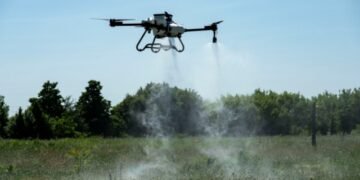
The most direct saving comes from the cost of each treated hectare. The CDA spraying system of the L-series uses up to 90 percent less water and up to 50 percent less chemical than conventional equipment, according to ABZ Innovation’s field data. Fuel for the tractor, driver hours, and wear on heavy machinery are also reduced. Depending on the operation, total operating costs can fall by up to 75 percent.
Treated area per working day
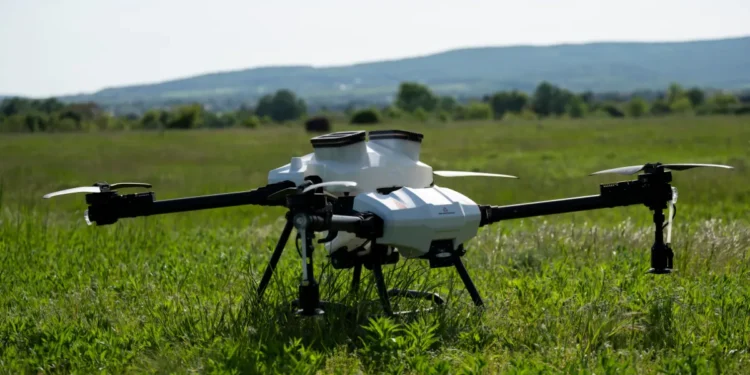
Revenue from contract spraying or savings on the farm’s own fields both scale with the daily capacity of agro drones. The L50 covers approximately 24 hectares per hour under suitable conditions, and the L30 V2 around 21 hectares per hour. Battery rotation, refill logistics, and the distance between fields decide how much of that theoretical capacity turns into real output. A well-organized ground team is as important for the return as the aircraft itself.
Which figures should go into the calculation?
A realistic estimate for agro drones requires a few inputs from the farm’s records:
- hectares treated per season and number of passes
- current cost per hectare for spraying and spreading
- losses from crop trampling and delayed treatments
- available working days when fields are too wet for tractors
- potential income from services offered to neighboring farms
With these numbers, the payback period can be calculated instead of guessed.
Reliability and service costs
The calculation only holds if the aircraft is available when the weather window opens. European engineering, CE and FCC compliance, and a stable supply of spare parts keep downtime short. Training reduces the risk of damage during the first season, when most operator errors occur. An innovation drone with reliable support therefore returns its cost faster than a cheaper platform with uncertain service.
From estimate to decision
The return on agro drones depends on cost per hectare, daily capacity, yield protection, and reliability working together. Each farm has a different mix, which is why ABZ Innovation offers demo flights and a savings calculator to compare the numbers for a specific operation. When the inputs are realistic, the payback period is usually shorter than the first season. For farms that also offer spraying services, the innovation drone becomes a source of income as well as a saving.