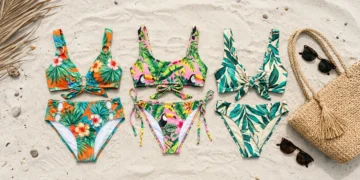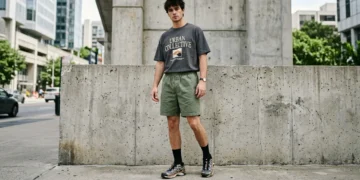


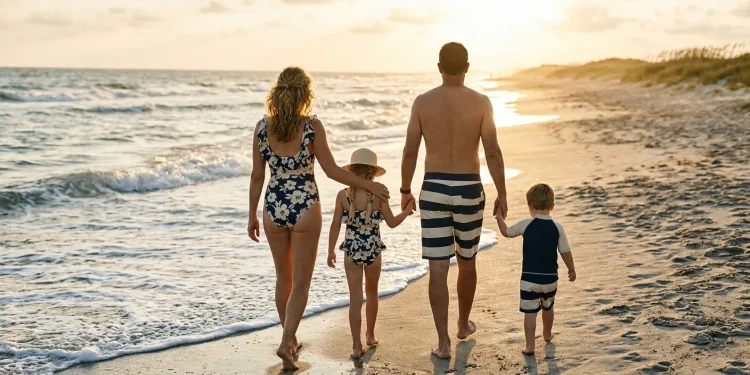
Minnow Swim is a Charleston-based swim and resortwear label built around one idea: the same print runs across sizes for women, men, girls, boys, and babies, so a whole family can coordinate without hunting across brands. If you’re planning a beach trip or family photos and want everyone in the same story, that print-repeat system is the thing that makes it work — and the thing worth understanding before you order.
This guide covers how the matching actually functions, the coordination formula that looks better than head-to-toe identical, what a family set realistically costs, the sizing quirk that catches first-time buyers, and whether the price makes sense for your situation.
What Minnow Swim Actually Is
Minnow is a contemporary children’s swimwear label and resort brand built around clean lines, simple details, and a seaside aesthetic. It was founded by a mom who now lives in Charleston, South Carolina, and the Southern coastal influence shows in everything from the color palettes to the ruffle details.
The brand’s core is cheerful, classic swim and resortwear for the whole family, built around coordinating pieces for women, girls, boys, babies, and men, with signature gingham, floral, and stripe prints. Beyond swimsuits, the range extends into rash guards, cover-ups, French terry sets, sun hats, and other beach accessories.
One practical note before anything else: a brand’s active prints rotate by season and sell through quickly, especially in popular sizes. Everything below describes how the system works rather than which specific print you’ll find in stock this week.
How the Matching Actually Works
This is the part most roundup articles skip, and it’s the whole reason people choose this brand over assembling looks from four different retailers.
Prints Repeat Across Every Size Category
A single print — say a block print floral or a two-tone stripe — gets produced across the full size range at once. That means the same pattern appears on a women’s one-piece, a men’s boardie, a girls’ ruffle suit, a boys’ trunk, and a baby suit. Because prints repeat across the line, you can pair a women’s suit with matching girls’, boys’, and baby styles for coordinated family photos.
Contrast that with the usual approach: buying a mom suit from one brand and hunting for a “close enough” kids’ print somewhere else. The colors are never quite right, and it shows in photos.
Silhouettes Differ Even When Prints Match
The matching happens at the print level, not the cut. A women’s version might be a ruffle-strap one-piece while the girls’ version is a ruffle collar and the boys’ is a simple boardie short. Everyone wears something appropriate for their age and body, unified by the fabric.
That’s the detail that keeps family matching from looking like a costume. Nobody’s dressing a six-year-old in a miniature adult silhouette, and dad isn’t in anything he’d be embarrassed to wear at a public pool.
Coverage Options Sit Inside the Same Prints
Rash guards, long-sleeve styles, and cover-ups often come in the same prints as the suits. For families with a kid who burns easily, or a parent who’d rather have shoulder coverage, you can mix a rash guard into the family set without breaking the look.
The Coordination Formula: Matching But Not Quite
Here’s the single most useful styling idea for this category, and it runs counter to what most people assume. Full head-to-toe identical matching is rarely the best-looking option. The approach that photographs better is coordinated-but-varied — what one roundup described as a “matching but not quite” approach to these palettes.
Three ways to execute it:
1. Same print, different colorways. If a stripe comes in navy and in sage, put half the family in each. The pattern unifies; the color variation keeps it from reading as a uniform.
2. One anchor print, rest in solids. Pick the busiest print for one or two people (often the youngest kids, where it reads as charming), and put everyone else in solid colors pulled from that print. If the floral has cream, navy, and rust in it, those are your three solid options.
3. Same palette, different patterns. A gingham and a stripe in the same two colors read as a set. This is the most sophisticated version and works especially well when adults want something less busy than the kids.
A quick way to test any combination before you order: pull up the product photos, screenshot each piece, and drop them side by side in your phone’s photo editor. Five minutes of this prevents the “these looked better separately” realization after everything arrives.
Think About Your Backdrop
Families planning photos should consider where they’ll be standing. Pale blues and whites can wash out against bright sand and sky at midday. Deeper tones — navy, forest, rust — hold up better in strong light. Against dark rocks or a green-heavy backdrop, lighter palettes pop more.
It’s a small consideration that makes a visible difference, and almost nobody thinks about it until they’re reviewing the photos.
Sizing: The Thing to Get Right Before Ordering
The brand carries swimwear for girls, boys, women, and men, with a sizing guide for each category. Use them — the categories don’t follow a single universal chart.
The most consistent feedback across independent reviews: the kids’ suits tend to run small. One reviewer who tested the brand on a toddler found the suits adorable and well-constructed but noted they ran small. If your child is between sizes, or close to the top of a range, the common advice is to size up.
A few practical sizing notes:
- Swim fabric has no give the way knits do. A suit that’s “a little snug” in the fitting room is a suit your kid will fight you about at the beach.
- Adult fit runs snug by design. The brand’s swimwear is described as having a snug, European-inspired fit for a sleek look. That’s a style choice, not a sizing error, but it’s worth knowing if you prefer a relaxed cut.
- Fit preferences vary genuinely. Reviews are enthusiastic about the kids’ swim and more mixed on adult swim — one tester who loved the children’s pieces ultimately preferred a different brand for her own suits. Worth factoring in if the adult piece is your biggest spend.
- Check the return policy before ordering multiple sizes. The brand publishes one; terms change, so read the current version rather than assuming.
Order in the Right Sequence
If you’re building a family set from a specific print, order everything in one transaction rather than piecemeal. Popular prints sell through in adult sizes first and in the middle kids’ sizes next. Buying the children’s pieces this week and planning to add the women’s suit next month is how families end up with a near-match instead of a match.
What a Family Set Actually Costs
Price is the honest sticking point with this brand, and vague language about “investment pieces” doesn’t help anyone plan. Here’s a realistic picture using price points reported in independent coverage — all of which should be verified against current listings, since pricing changes seasonally.
| Piece | Reported price range |
|---|---|
| Baby swim | from around $48 |
| Kids’ unisex rash guard | around $54 |
| Boys’ boardie short | around $58 |
| Girls’ bikini / suit | around $64 |
| Women’s suit | around $180 (bikini sets reported near $102 top / $80 bottom) |
A family of four — two adults, two kids — can expect to land somewhere in the mid-hundreds for a full coordinated set at full price. One roundup summarized it directly: the collections are genuinely cute, but it’ll cost you a pretty penny.
Three ways families reduce that:
- Shop end-of-season. Third-party retailers like Saint Bernard have carried Minnow pieces at significant markdowns on past-season prints. Nordstrom, Maisonette, and J.Crew have also stocked the brand at various points.
- Match the kids only. Sibling matching with parents in coordinating solids from any brand captures most of the visual effect at a fraction of the cost.
- Buy for hand-me-downs. This is the argument that actually justifies the price for multi-kid families — see below.
Is the Quality Worth the Price?
Reviewers consistently point to durability as the brand’s strongest practical argument. One review described the fabric as a clear upgrade over cheap family swimsuits and built to last beyond a single season, unlike fast-fashion suits that fade or fall apart. Another parent noted that hand-me-downs from an older child looked brand new on the younger one.
That second point is the real math. A $60 girls’ suit worn by two or three children across multiple summers has a very different cost-per-wear than the same $60 spent on three $20 suits that each last one season. If you have one child and they’ll outgrow it in a year, that argument is much weaker.
The honest counterweights:
- Prices sit well above mass-market alternatives, and no fabric quality erases that gap for budget-conscious families.
- Adult fit satisfaction varies more than kids’ fit satisfaction across reviews.
- Chlorine is hard on every swimsuit regardless of price. A premium suit that lives in a chlorinated pool five days a week will still degrade.
Making a Family Set Last
Most swimsuit damage is preventable, and it mostly happens between swims rather than during them. The routine that matters:
- Rinse in cool fresh water immediately after every use. Chlorine and salt do their damage while sitting in the fabric, not while you’re in the water.
- Never wring. Press the water out gently. Twisting breaks down the elastane that gives swimwear its stretch.
- Dry flat in shade. Direct sun fades prints and degrades fibers; a hot dryer destroys elastic fast.
- Skip the washing machine unless the care label explicitly permits it. Hand wash in cool water with a gentle detergent.
- Rotate between two suits on long trips so each gets a full dry cycle. This single habit extends swimsuit life more than anything else.
- Store dry and flat. A damp suit balled in a beach bag overnight is how mildew and odor start.
For hand-me-downs, add one step: wash, fully dry, and store in a breathable cotton bag rather than plastic, which traps residual moisture.
Sun Protection: What Matching Swimwear Can and Can’t Do
Many pieces in this category are made with UPF fabrics, and retailers stocking the brand highlight that. UPF — Ultraviolet Protection Factor — measures how much UV radiation a fabric blocks, and it’s a genuinely useful layer for kids who won’t sit still for reapplication.
What it doesn’t do is replace sunscreen on exposed skin. Faces, hands, feet, and the back of the neck still need coverage, and shade and timing still matter. The American Academy of Dermatology and the Skin Cancer Foundation both publish current guidance on sun-protective clothing, UPF ratings, and safe sun practices for children, including advice specific to infants under six months.
Two practical reminders: UPF protection can weaken as fabric stretches or wears thin over years of use, and a wet garment may offer less protection than a dry one depending on the fabric construction. Check the specific product’s UPF rating rather than assuming all pieces in a line carry one, and for anything involving a child’s skin condition or a history of sun sensitivity, ask a pediatrician or dermatologist rather than relying on a product label.
Who This Brand Fits, and Who It Doesn’t
A good match if you:
- Want genuine whole-family coordination including dad and baby, which many brands don’t offer
- Are planning family photos where the outfits are part of the plan
- Have multiple kids who’ll pass pieces down
- Prefer classic, preppy coastal styling over trend-driven swimwear
Probably not your brand if you:
- Need suits for daily chlorinated swim lessons, where you’ll replace them regardless
- Have one child who’ll outgrow everything in a season
- Prefer bold, contemporary, or minimalist swimwear aesthetics
- Want a relaxed rather than snug adult fit
Either way, a worthwhile step before committing: buy one piece first. A single kids’ suit tells you how the sizing runs for your child and how the quality feels in hand, for a fraction of the cost of discovering it across a full family order.
The Takeaway
The real value in a Minnow Swim family set isn’t the matching itself — plenty of brands offer that. It’s the print continuity across every size from infant to adult men’s, which removes the guesswork that makes family coordination frustrating everywhere else. Use that system well by coordinating rather than cloning, size the kids’ pieces up if they’re between sizes, order everything in one go before prints sell through, and build a rinse-and-dry habit that gets you multiple seasons out of the spend.
Start with one piece in a print you like, see how it fits your family, then build the set around it.
FAQ
Does Minnow Swim have matching options for dads and boys?
Yes. The brand’s collections include men’s and boys’ pieces — typically boardies and trunks — in the same prints as the women’s and girls’ styles, which is less common than mom-and-daughter-only matching.
Does Minnow Swim run small?
Independent reviews consistently report that the kids’ suits run small, and the adult swim is cut with a deliberately snug, European-inspired fit. Sizing up is the common recommendation when a child is between sizes. Check the current size guide for each category before ordering.
Where can I buy Minnow Swim besides the official site?
Pieces have been stocked by third-party retailers including Maisonette, J.Crew, and Saint Bernard at various times, sometimes at markdowns. Availability through those channels changes, so verify current stockists directly.
Is it worth the price compared to cheaper matching swim brands?
It depends on use. Reviewers describe the fabric as durable enough to outlast a single season and hold up through hand-me-downs, which improves cost-per-wear for multi-child families. For a single child or heavy chlorinated pool use, a less expensive brand may make more sense.
Do the prints come back the following year?
Not reliably. Swim collections rotate seasonally, and popular prints sell through. If you want everyone in the same print, order the full family set at once rather than adding pieces later.