


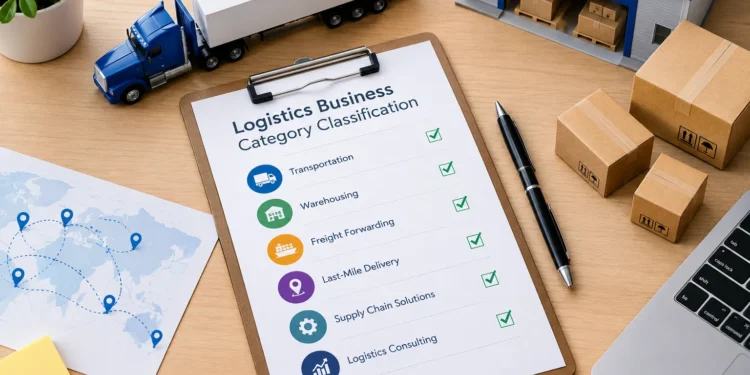
Pick the wrong category for a logistics company and the problems show up later: insurance quotes priced for the wrong risk, government contracts you never appear in, and a Google listing that ranks for searches your customers don’t make. So what is logistics business category classification, in plain terms? It’s the process of matching your company’s primary activity to the standardized labels used by government systems (mainly NAICS codes in the US), licensing bodies, insurers, and business platforms. The core rule is simple: classify by what generates most of your revenue, not by everything you could theoretically do.
That one rule solves most cases. The rest of this guide covers the specific codes, the systems where your category actually matters, and the mistakes that trip up new logistics operators.
What Is Logistics Business Category Classification?
Logistics business category classification means assigning your company to the standardized industry categories used across several different systems. In the US, the main ones are:
- NAICS codes — the North American Industry Classification System, used by the Census Bureau, IRS, SBA, and federal contracting systems
- SIC codes — an older system some banks, insurers, and state agencies still reference
- Operating authority types — FMCSA’s distinction between carrier, broker, and freight forwarder, which is a legal registration, not just a label
- Platform categories — Google Business Profile, Yelp, and industry directories, which affect who finds you
Here’s the part that confuses people: these systems don’t use the same labels, and one company often needs a different answer in each. A freight brokerage might be NAICS 488510 for its SAM.gov profile, hold broker authority with FMCSA, and list as “Freight forwarding service” or “Logistics service” on Google because no perfect category exists there. That’s normal, not a contradiction.
Why the Category You Choose Actually Matters
It’s tempting to treat classification as paperwork. In practice, the choice has teeth in at least four places.
Small business size standards. The SBA sets a different revenue or employee threshold per NAICS code, and the code determines which SBA size standard applies for small business eligibility. Pick a code with a low threshold and you might lose small-business status (and set-aside contract eligibility) earlier than a competitor doing identical work under a different code.
Government contracts. Agencies search registered vendors by NAICS code when they do market research. If your SAM.gov profile doesn’t include the codes buyers search, your business simply doesn’t appear when agencies conduct market research in that industry.
Insurance pricing. Underwriters rate trucking, warehousing, and brokerage very differently. A misclassified operation can end up overpaying, or worse, with a policy that doesn’t actually cover its real activity.
Local search visibility. Your primary Google Business Profile category heavily influences which searches you show up for. “Trucking company” and “Logistics service” pull different queries and different customers.
The Main NAICS Categories for Logistics Companies
Almost every logistics business lands somewhere in NAICS sector 48-49, Transportation and Warehousing, or in one consulting code outside it. The table below maps common business types to their usual codes. Treat it as a starting point, then confirm the official definition on the Census Bureau’s NAICS site before filing anything.
| What your company mainly does | Typical NAICS code | Category name |
|---|---|---|
| Hauls freight with its own trucks (full truckload, general freight) | 484121 / 484110 | General Freight Trucking |
| Moves household goods | 484210 | Used Household and Office Goods Moving |
| Arranges shipments but doesn’t own trucks (broker, forwarder) | 488510 | Freight Transportation Arrangement |
| Packs and crates goods for transport | 488991 | Packing and Crating |
| Delivers parcels and documents | 492110 | Couriers and Express Delivery Services |
| Local small-item delivery | 492210 | Local Messengers and Local Delivery |
| Stores goods, runs fulfillment, 3PL warehousing | 493110 | General Warehousing and Storage |
| Advises other companies on supply chains without moving freight | 541614 | Process, Physical Distribution, and Logistics Consulting Services |
Two of these deserve a closer look because they’re the most commonly confused.
488510 vs. 484: Do You Own the Trucks?
This is the dividing line most new operators get wrong. If your revenue comes from hauling freight in equipment you own or lease, you’re a carrier under the 484 trucking codes. If you earn margins by connecting shippers with carriers, you’re in 488510, Freight Transportation Arrangement — even if you call yourself a “trucking company” in your marketing. The classification follows the activity, not the branding.
541614: The Consulting Trap
NAICS 541614 covers businesses engaged in process, physical distribution, and logistics consulting services. The word “logistics” in the title makes it a magnet for companies that don’t belong there. Some classification tools even suggest it for 3PL warehouses, but a warehouse that physically stores and ships goods fits far better under 493110. Reserve 541614 for firms whose product is advice — network design, route optimization studies, supply chain audits — not physical handling.
A Four-Step Method to Identify Your Category
When the table above doesn’t settle it, work through these steps in order.
- Follow the revenue. List your service lines and estimate what percentage of income each produces. Your primary classification should match the largest slice today, not the business plan for next year.
- Apply the asset test. Do you own or lease the trucks and warehouses, or do you coordinate other people’s? Asset-based operations classify as carriers or warehousers; non-asset operations classify as arrangement, brokerage, or consulting.
- Check the official definition, including cross-references. NAICS entries list exclusions that redirect you. For example, packing goods for transport is 488991, but establishments primarily engaged in providing packaging and labeling services are classified in 561910 instead. Those small distinctions are exactly where misfilings happen.
- Add secondary codes where the system allows it. SAM.gov profiles can carry multiple NAICS codes. Set the primary to your main activity, then add secondaries for real, revenue-producing services so you surface in more contract searches.
Choosing Categories Beyond Government Codes
Google Business Profile
Google’s category list won’t match NAICS, so translate rather than transplant. Pick the most specific primary category that describes you — “Trucking company,” “Freight forwarding service,” “Warehouse,” “Logistics service,” or “Moving company” — then add two to four secondary categories for genuine services. Avoid stacking loosely related categories to widen reach; it dilutes relevance and can hurt rather than help. Category names on Google change periodically, so re-check what’s available when you set up the listing.
FMCSA Operating Authority
For US interstate freight, your category is also a legal registration. Carriers, brokers, and freight forwarders each need distinct operating authority, and a broker arranging loads under carrier-only authority is a compliance problem, not a labeling one. If your model mixes activities — say, a carrier that also brokers overflow loads — you’ll typically need both authorities. This is one area where guessing is a bad idea; confirm requirements with FMCSA directly or through a transportation attorney.
Insurance and Banking
Insurers and some lenders still ask for SIC codes or their own class codes. Describe your actual operation honestly rather than hunting for the cheapest-sounding class. A mismatch discovered at claim time costs far more than any premium saved.
Common Classification Mistakes to Avoid
- Classifying by ambition. A courier startup planning to become a 3PL should still file as 492110 until warehousing revenue actually leads.
- Using “logistics” as the answer everywhere. It’s a broad umbrella word; every system wants something more specific underneath it.
- Copying a competitor’s code. Their mix of assets and services may differ from yours in ways that change the correct answer.
- Setting it once and forgetting it. Businesses evolve. Review your codes and platform categories once a year, and whenever a new NAICS revision is released — the system is updated roughly every five years, most recently in 2022 as of this writing.
- Treating all systems as one decision. Your NAICS code, FMCSA authority, and Google category are three separate choices that should each be made on that system’s terms.
The Takeaway
Understanding what logistics business category classification involves comes down to one discipline: name the activity that earns most of your money, then express that activity correctly in each system — NAICS for registration and contracts, operating authority for legal compliance, and platform categories for visibility. Spend an hour getting it right at setup, put a yearly review on the calendar, and bring in a professional for the legal and tax-sensitive pieces. For anything tied to taxes, regulatory registrations, or customs, confirm your classification with the relevant authority or a qualified professional rather than relying on a lookup tool alone.
FAQ
What NAICS code should a freight broker use?
Typically 488510, Freight Transportation Arrangement. Brokers don’t operate the trucks, so the 484 carrier codes don’t apply, and they’ll also need broker authority from FMCSA.
Can a logistics company have more than one NAICS code?
Yes. Systems like SAM.gov allow a primary code plus secondaries. The primary should reflect your largest revenue source; secondaries cover other real service lines.
Is a 3PL warehouse classified as consulting under 541614?
Usually not. If the company physically stores and ships goods, 493110 (General Warehousing and Storage) is the better fit. 541614 is meant for firms selling logistics advice rather than handling freight.
Do NAICS codes affect taxes?
The code itself doesn’t set your tax rate, but it appears on federal filings and affects SBA size standards, some state requirements, and how agencies and lenders categorize you. Confirm specifics with an accountant.
How do I find the official definition of a code?
Use the search tool on the US Census Bureau’s NAICS website, which publishes full definitions, examples, and cross-references for every code.