


Fundamentals of Pay Per Lead Marketing
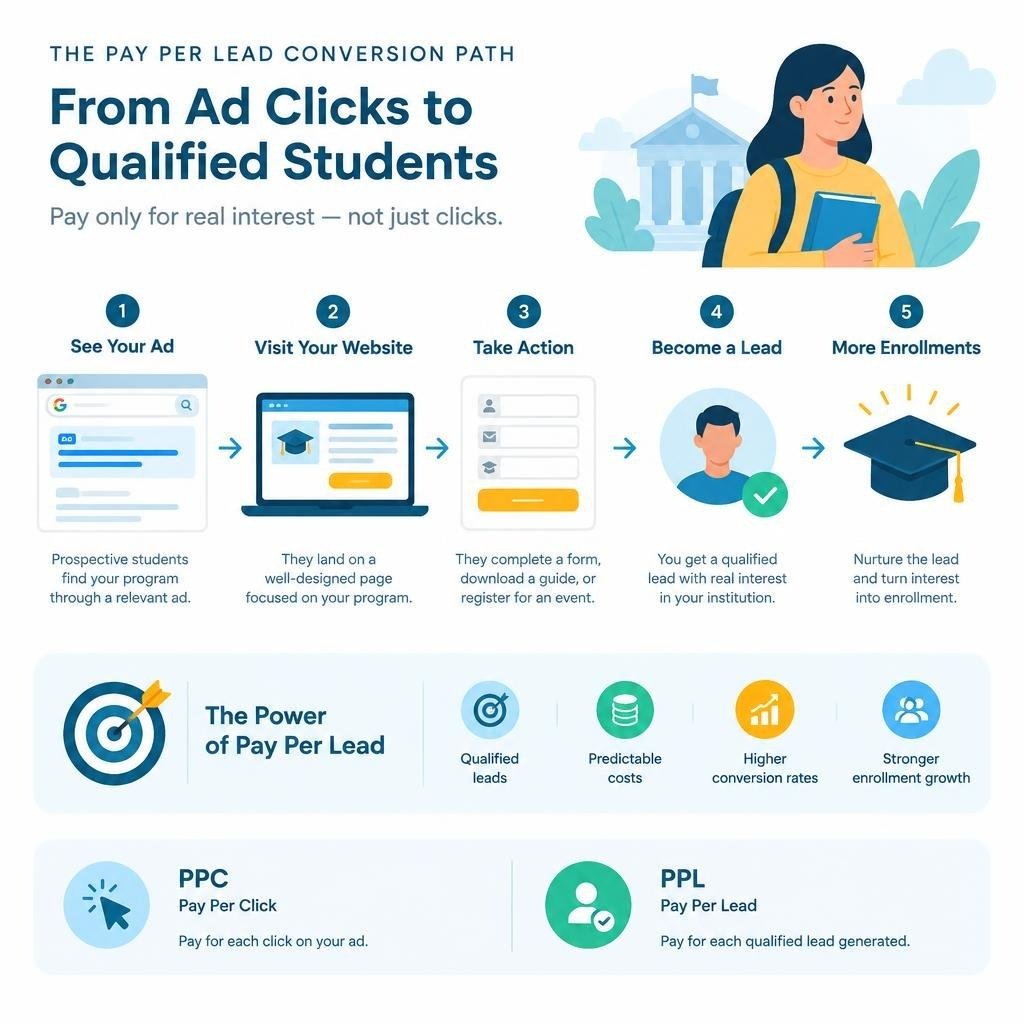
Pay Per Lead (PPL) marketing in education shifts the focus from mere visibility or clicks to tangible, qualified interest. Instead of paying for every click (Pay Per Click, PPC), institutions pay when a prospective student completes a specific action, such as filling out an inquiry form, downloading a program guide, or registering for an open day.
This model inherently aligns marketing spend with lead generation, making it a powerful strategy for institutions aiming for predictable enrollment growth.
The core of PPL success lies in understanding lead generation, managing acquisition costs, optimizing conversion rates, leveraging intent data, and ultimately maximizing marketing ROI. For educational institutions, a lead isn’t just any contact; it’s a prospect who has shown genuine interest and meets certain qualification criteria, making them more likely to progress through the admissions funnel.
Understanding the distinction between PPC and PPL is crucial. While PPC aims to drive traffic to your website, PPL focuses on converting that traffic into actionable leads. This often involves a more rigorous approach to landing page optimization, call-to-action clarity, and robust conversion tracking.
Here’s a comparative look at the two models:
Feature Pay Per Click (PPC) Pay Per Lead (PPL) Billing Model Pay for each click on your ad Pay for each qualified lead generated Primary Goal Drive traffic to website Generate qualified inquiries/applications Risk Institution bears risk of traffic not converting Agency/Platform often shares risk of conversion Focus Ad impressions, clicks, CTR Lead quality, conversion rate, cost per lead Cost Driver Keyword bids, ad relevance, competition Lead volume, lead quality, conversion efficiency Best For Brand awareness, high-volume traffic, initial engagement Direct response, measurable lead acquisition, enrollment targets
Core Mechanics of Pay Per Lead Marketing Campaigns
Effective PPL campaigns for education are built on several foundational mechanics. First, search intent is paramount. We aim to intercept prospective students when they are actively searching for programs, degrees, or institutions like yours.
This means targeting high-intent keywords such as “online MBA programs,” “nursing schools near me,” or “data science master’s degree.” By aligning ads with specific user queries, we ensure that the traffic driven is highly relevant and more likely to convert into a lead.
Next, managing cost per acquisition (CPA) is central to PPL. While the term “pay per lead” implies a fixed cost per lead, in practice, institutions often manage their campaigns to optimize for the lowest possible CPA for a qualified lead.
This involves continuous monitoring and adjustment of bids, ad creatives, and targeting parameters. The average CPC for Google Ads in higher education can be around £4.90, but the ultimate goal is to drive down the cost of a qualified inquiry, not just a click.
Robust conversion tracking is non-negotiable. For PPL, we must accurately track every desired action on the website, from initial inquiry form submissions to application starts and completions.
This often involves setting up Google Analytics 4 (GA4) with precise event tracking, integrating with CRM systems, and utilizing Enhanced Conversions to get a clearer picture of the user journey. Without accurate tracking, it’s impossible to attribute leads to specific campaigns or optimize for better performance.
Landing page optimization plays a critical role. The ad might attract attention, but the landing page is where the conversion happens. These pages must be highly relevant to the ad copy and the user’s search query, offer clear value propositions, provide all necessary information (curriculum, outcomes, tuition), and feature prominent, easy-to-use inquiry forms. A seamless user experience on the landing page directly impacts conversion rates.
Finally, lead quality is the ultimate determinant of PPL success. It’s not just about generating leads, but generating leads that have a high propensity to enroll. This requires careful audience segmentation, using negative keywords to filter out irrelevant searches (e.g., “free courses,” “visa sponsorship” for certain international campaigns), and ensuring that ad messaging attracts the right type of student.
For instance, focusing on “flexible MBA for working professionals” targets a different quality of lead than a generic “MBA program.”
Setting Realistic Benchmarks and Budgets
Establishing realistic benchmarks and allocating appropriate budgets are critical for sustainable PPL success in education. The average CPC for Google Ads in higher education is approximately £4.90, with a median CTR of 5.7%. However, these are just starting points.
The true measure of success in PPL is the cost per lead (CPL). Industry benchmarks for education can range widely, but a median CPL might fall between £75–100, though this can vary significantly based on program competitiveness, institution type, and geographic targeting.
Some sources indicate a 2026 education and instruction benchmark CPL of $90.02. Community colleges might see CPLs of $30-60, while graduate programs could exceed $150-200.
Conversion rate is another key benchmark. The education and instruction vertical boasts a relatively high conversion rate benchmark of 11.4% in 2026, reflecting the strong intent of searchers. However, this is for inquiries. The inquiry-to-enrollment rate typically ranges from 10-25%, meaning not every inquiry will become a student. Understanding this funnel is essential for accurate forecasting.
Budget allocation for Google Ads in education should be strategic and data-driven. While specific figures depend on the institution’s size and goals, minimum viable monthly budgets are often cited as:
- $5,000 for community colleges
- $15,000 for mid-sized regional universities
- $50,000+ for large research universities
For individual programs, budgets can range from $800-2,500/month for long-tail programs to $3,000-12,000/month for flagship programs. Many schools with 10+ program campaigns invest $10,000-30,000/month overall.
It’s also recommended to allocate 10-30% of the budget to top-of-funnel campaigns like YouTube and Discovery ads to build demand and warm audiences, which can make bottom-funnel search campaigns more efficient.
Finally, consider the lifetime value (LTV) of an enrolled student. A single enrollment can represent tens or even hundreds of thousands of dollars in tuition revenue over several years.
This long-term value justifies a higher initial CPA for qualified leads, provided the conversion rates from lead to enrollment are healthy. For instance, an institution might tolerate a higher CPL if it consistently leads to enrollments with a strong ROI, such as the 14:1 payback seen by one regional US university after 12 months.
Strategic Campaign Frameworks for High-Quality Acquisition
To achieve high-quality lead acquisition, educational institutions need a sophisticated campaign framework that goes beyond simple keyword targeting. This involves meticulous audience segmentation, a comprehensive full-funnel strategy, and a clear distinction between demand capture and demand generation efforts.
Audience segmentation means understanding who you are trying to reach. This could involve segmenting by:
- Program of interest: Undergraduate, Graduate, Certificate, specific degree types (MBA, Nursing, Engineering).
- Demographics: Age, location, parental status (for K-12 or undergraduate recruitment).
- Intent: Early-stage researchers vs. those ready to apply.
- Persona: Students vs. parents (who often have different search behaviors and concerns).
- International vs. Domestic: Different needs, keywords, and landing page content.
A full-funnel strategy acknowledges that prospective students are at different stages of their decision-making journey. This typically involves:
- Awareness/Curiosity: Introducing your institution or programs to a broad, relevant audience.
- Consideration/Research: Engaging prospects who are actively exploring options.
- Conversion/Application: Capturing leads ready to inquire or apply.
Demand capture focuses on intercepting existing demand – people actively searching for what you offer. This is primarily achieved through Google Search Ads. Demand generation, on the other hand, aims to create interest and awareness among potential students who might not yet be actively searching. This often leverages platforms like YouTube, Display Network, and Discovery ads. A balanced approach across both is crucial.

Search and Intent Capture Optimization
Optimizing search campaigns is the cornerstone of effective PPL for education, as it directly targets high-intent prospects. The goal is to appear prominently when prospective students are actively looking for programs. This requires a robust strategy for high-intent keywords. We focus on:
- Program-specific terms: “online master’s in cybersecurity,” “part-time MBA London.”
- Location-based terms: “best universities in [city],” “community colleges near me.”
- Problem/solution queries: “career change programs,” “upskill for data science.”
- Competitor terms: Bidding on competitor names can capture audiences considering alternatives.
Crucially, negative keywords are just as important as positive ones. These prevent your ads from showing for irrelevant searches, minimizing wasted budget and improving lead quality. Examples include “free,” “scholarship only,” “jobs,” “visa sponsorship” (if not applicable). Regularly reviewing search terms reports helps identify new negative keyword opportunities.
Responsive Search Ads (RSAs) are vital in October 2026. These allow you to provide multiple headlines and descriptions, and Google’s AI will automatically test and combine them to show the most effective ad variations to different users. This maximizes relevance and click-through rates. Ad copy should highlight unique selling propositions (USPs) such as faculty expertise, career outcomes, flexible learning options, and accreditation. For instance, an ad might read: “Advance Your STEM Career – Apply for Our Data Science Program.”
Effective search campaigns are about more than just clicks; they’re about generating calls and sales—or, in education, qualified inquiries and applications. This means aligning ad copy with landing page content, ensuring a seamless user journey from search query to conversion.
Multi-Stage Retargeting and Lead Nurturing
Not every prospect converts on their first visit. This is where multi-stage retargeting and lead nurturing become indispensable for educational institutions, especially given the long enrollment cycles (6-18 months).
Remarketing (or retargeting) campaigns allow us to re-engage users who have previously interacted with your website or ads but haven’t converted. This can be segmented based on their previous behavior:
- General website visitors: Show general brand awareness ads.
- Program page viewers: Show ads specific to the programs they viewed, perhaps highlighting unique benefits or testimonials.
- Inquiry form abandoners: Remind them to complete their inquiry with a clear call to action.
- Application starters: Provide prompts or assistance to complete their application, perhaps with scholarship reminders or deadline alerts.
Dynamic Search Ads (DSAs) can complement traditional search campaigns by automatically generating headlines and landing pages based on your website content. This is particularly useful for institutions with many programs or frequently updated content, ensuring comprehensive coverage for long-tail searches that might be missed by manual keyword targeting.
For mid-funnel engagement, video ads (e.g., campus tours, student testimonials) and display ads can keep your institution top-of-mind. These campaigns help nurture interest and build familiarity, making it more likely for prospects to convert when they are ready.
Crucially, CRM integration is the backbone of effective lead nurturing. Connecting your Google Ads data with your Customer Relationship Management system allows for:
- Offline conversion tracking: Uploading enrollment data back into Google Ads to optimize for actual enrollments, not just inquiries.
- Audience syncing: Creating custom audiences in Google Ads based on CRM data (e.g., prospects who attended an open day but haven’t applied).
- Personalized follow-up: Ensuring that leads receive relevant communications based on their ad interactions and inquiry details.
This integrated approach leads to a significant conversion lift, as prospects are guided through a personalized journey, increasing their likelihood of becoming enrolled students.
Conversion Rate Optimization and Lead Handling
Generating leads through Google Ads is only half the battle; converting those leads into enrolled students requires meticulous attention to conversion rate optimization (CRO) and efficient lead handling. The journey from an ad click to a submitted inquiry, and then to an enrollment, must be as smooth and compelling as possible.
Landing page alignment is paramount. Your landing page content, messaging, and visuals must directly match the ad that brought the user there. If an ad promises a “Flexible Online MBA,” the landing page should immediately deliver information on flexibility, online learning, and MBA specifics, not a generic homepage. Dedicated landing pages for each program or campaign theme consistently outperform generic pages.
Form optimization is another critical area. Inquiry forms should be concise, asking only for essential information initially. Long, complex forms can deter prospects. Consider multi-step forms for longer applications, breaking them into manageable chunks. Ensure forms are mobile-friendly and clearly indicate progress.
Response speed to incoming leads is a significant factor in conversion. Research indicates that the average response time to a prospect email at private schools is a staggering 47 hours. However, 67% of prospect website activity occurs outside business hours, and 91% of school website visitors leave without making first contact. This highlights a massive opportunity for institutions that can respond quickly.

Implementing automated response mechanisms is essential. An immediate email confirmation after an inquiry, perhaps with links to relevant program details or FAQs, keeps the prospect engaged. This can be followed by a personalized outreach from an admissions counselor within a few hours.
Lead scoring helps prioritize follow-up efforts. By assigning scores based on prospect behavior (e.g., pages visited, program interest, demographic data), admissions teams can focus on the highest-quality leads first, improving efficiency and conversion rates.
Scaling ROI Through Pay Per Lead Marketing Automation
To truly scale ROI in PPL marketing for education, automation is key. This allows institutions to handle a larger volume of leads efficiently, ensuring no prospect falls through the cracks and that engagement is consistent and timely.
Automated qualification tools, such as AI chatbots, can significantly enhance lead quality and response times. Chatbots like Skolbot can answer prospective students’ questions 24/7, capturing contact information and pre-qualifying leads based on their queries. This is crucial given that 67% of prospect website activity occurs outside business hours. Chatbot deployment can lead to a median 62% increase in qualified leads and a median ROI of 280% in student recruitment. They can even auto-register prospects for open days, leading to a +40% increase in sign-ups.
24/7 engagement provided by chatbots addresses the issue of prospects leaving websites without contact. While schools’ websites answer only 5 of 15 most-asked prospect questions on average, an AI chatbot can provide instant, accurate answers, improving the user experience and capturing leads around the clock.
Lead routing automation ensures that inquiries are immediately directed to the appropriate admissions counselor or department based on program interest, geographic location, or other criteria. This reduces internal delays and ensures the right person follows up.
Seamless CRM sync is fundamental. When a lead is generated, their information should automatically flow into the CRM system. This allows for automated follow-up sequences, tracking of all interactions, and a unified view of the prospect’s journey. This integration is vital for attributing enrollments back to specific marketing efforts and optimizing future campaigns.
These automation strategies contribute to increased pipeline velocity. By streamlining lead capture, qualification, and initial engagement, institutions can move prospects through the admissions funnel more quickly and efficiently, leading to higher enrollment rates and a stronger return on their Google Ads investment.
Frequently Asked Questions about Pay Per Lead Digital Marketing
What is the difference between pay per click and pay per lead marketing?
The fundamental difference between Pay Per Click (PPC) and Pay Per Lead (PPL) marketing lies in their billing model and what constitutes a billable event. In PPC, advertisers pay each time a user clicks on their ad, regardless of whether that click results in a conversion (like an inquiry or application). The primary goal of PPC is to drive traffic to a website.
In contrast, PPL involves paying only when a qualified lead is generated. This means the advertiser pays when a user completes a specific, pre-defined action, such as filling out an inquiry form, downloading a brochure, or registering for an event. The risk allocation is different; with PPL, the agency or platform often shares more of the conversion risk. PPL focuses on acquiring qualified inquiries rather than just traffic, aiming for higher cost efficiency in terms of actual lead generation. While PPC is about traffic acquisition, PPL is about acquiring actionable prospects.
How do you measure the true ROI of a pay per lead campaign?
Measuring the true ROI of a PPL campaign in education requires looking beyond just the cost per lead (CPL). While CPL is a crucial metric, ROI is determined by the ultimate value generated. Key metrics include:
- Sales conversion rate: For education, this translates to the inquiry-to-application rate and, more importantly, the application-to-enrollment rate.
- Customer lifetime value (CLTV): For educational institutions, this is the total tuition revenue a student generates over their enrollment period. A single enrollment can be worth tens of thousands of dollars.
- Offline attribution: Since enrollments often happen offline, connect online ad interactions with offline enrollment data. This can be done by uploading offline conversions (e.g., enrolled students) back into Google Ads using GCLIDs (Google Click Identifiers) or Enhanced Conversions for Leads.
- Pipeline payback: This involves calculating how long it takes for the revenue generated from enrolled students to cover the initial ad spend. Given the long enrollment cycles (8-18 months for higher education), ROI assessment needs a longer-term view, often 12-18 months, rather than just 30-day reporting.
By tracking these metrics, institutions can understand the full financial impact of their PPL efforts and optimize for actual enrollments and revenue, not just leads.
How quickly should incoming leads be contacted to ensure conversion?
The speed of contact for incoming leads is a critical factor in conversion rates. Research consistently shows that the faster a lead is contacted, the higher the likelihood of engagement and conversion. While the average response time at private schools can be as high as 47 hours, best practices suggest much quicker action.
Ideally, leads should be contacted within minutes, or at least within the first hour, of their inquiry. This is when their interest is highest. Automated responses (like an immediate email confirmation) can bridge the gap until a human can follow up. For human outreach, aiming for a response within 15-30 minutes during business hours significantly increases contact rates and the chances of qualifying the lead.
Rapid follow-up allows for quicker qualification speed, moving prospects efficiently into the sales (admissions) pipeline. Institutions leveraging AI chatbots can provide instant, 24/7 engagement, capturing information and initiating the qualification process immediately, even outside business hours. This proactive and timely engagement is crucial for maximizing the conversion potential of every lead generated.
Conclusion
In the dynamic educational landscape of October 2026, a strategic approach to Google Ads is no longer optional—it’s essential for sustainable growth. By embracing a Pay Per Lead (PPL) methodology, institutions can move beyond simply driving traffic to actively acquiring qualified prospective students.
This guide has outlined the critical components of such a strategy, from understanding the fundamentals of lead generation and setting realistic benchmarks to implementing sophisticated campaign frameworks and optimizing for conversion.
The journey to predictable student acquisition involves meticulous audience segmentation, a full-funnel approach that balances demand generation with demand capture, and continuous optimization of search campaigns.
Furthermore, leveraging multi-stage retargeting and integrating with CRM systems ensures that no lead is left behind. Crucially, efficient lead handling, rapid response times, and the strategic deployment of marketing automation tools like AI chatbots are pivotal for scaling ROI and enhancing the student recruitment pipeline.
By focusing on data attribution—connecting every ad dollar spent to actual inquiries, applications, and ultimately, enrollments—educational institutions can achieve long-term growth.
The goal is not just to get clicks, but to cultivate meaningful connections that translate into a vibrant and growing student body. With a well-executed PPL strategy, your institution can confidently navigate the competitive digital marketing environment and secure its future enrollment success.