


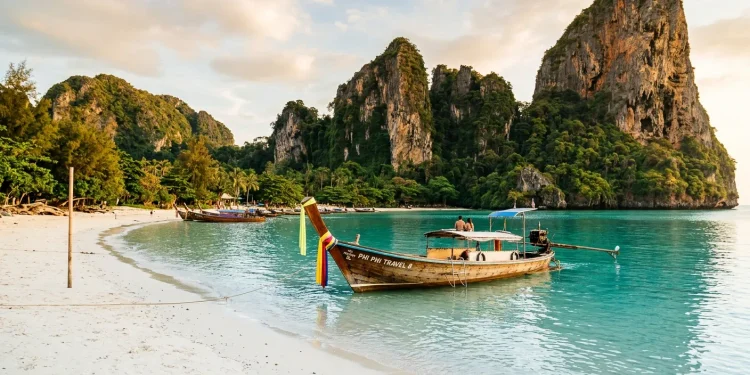
If you’re flying from the US to Thailand for the beaches, the short version is this: the best beaches in Thailand split across two coasts with opposite weather, so when you go matters as much as where. For the classic postcard scenery — Railay’s limestone cliffs, the Phi Phi Islands, Phuket’s west-coast sands — aim for the Andaman side between roughly November and April. For a trip in May through October, the Gulf islands like Koh Samui and Koh Tao usually stay drier. Get the coast-and-season match right and almost any beach below delivers.
This guide ranks the standout shores, says plainly who each one suits, and covers the planning details that trip up first-time visitors flying in from North America — the long haul, the two-monsoon calendar, and how to island-hop without wasting half your vacation in transit.
The One Thing to Understand First: Two Coasts, Two Seasons
Thailand’s roughly 3,200 km of coastline faces two different seas, and they don’t share a weather schedule. This is the single most useful thing to grasp before booking.
- Andaman coast (west): Phuket, Krabi, Railay, Phi Phi, Koh Lanta, Koh Lipe. Generally best from about November to April.
- Gulf of Thailand (east): Koh Samui, Koh Phangan, Koh Tao. The rhythm runs a bit differently, with its heaviest rain often later in the year, so it can be the smarter pick in the Andaman’s wet months.
Monsoon timing shifts year to year and these are broad patterns, not guarantees — check a current forecast for your exact dates before committing. But the principle holds: if your travel window is fixed, let it choose your coast rather than forcing a coast into the wrong month.
Why this matters more for US travelers: you’re likely spending 20+ hours in transit and a big chunk of change to get there. A rained-out week on the wrong coast is a costlier mistake from Chicago than from Singapore.
The Best Beaches in Thailand, Ranked by What They Do Best
Rather than a generic countdown, here’s each top escape matched to the kind of trip it actually rewards.
1. Railay Beach (Krabi) — Best for Dramatic Scenery
Railay is the image most people have in their heads when they picture Thailand: sheer limestone cliffs dropping straight into calm water, reachable only by longtail boat because mountains cut it off from the mainland road. That boat-only access keeps the pace slower than Phuket.
It’s a rock climber’s mecca, but you don’t need to climb to enjoy it. Walk between West Railay (sunset side, softer sand) and Phra Nang Cave Beach, widely considered the prettiest stretch here. Best for: couples, photographers, anyone who wants scenery over nightlife.
2. Phi Phi Islands — Best for the Classic Island-Hop
The Phi Phi group earns its fame honestly. Maya Bay — the cove from the movie The Beach — reopened with visitor rules after being closed to let its reef recover, so expect limits on how and when you can visit. Treat Phi Phi as a day-trip or a one-to-two-night stop rather than a base: it’s busy, and the magic is the boat tour through the lagoons.
A practical note travelers forget: the Phi Phi islands have no cars, and the main pier area gets crowded midday when tour boats converge. Early starts pay off everywhere in Thailand, and nowhere more than here.
3. Phuket’s West Coast — Best for First-Timers and Convenience
Phuket is Thailand’s largest island and its most developed, which is exactly why it suits a first trip. It has an international airport (so you skip a ferry on arrival), hospitals, every hotel tier, and beaches for different moods along one coast:
- Patong — the nightlife hub, loud and lively, love-it-or-leave-it
- Kata and Karon — family-friendly, calmer, good swimming
- Freedom Beach — a harder-to-reach stunner that made the World’s 50 Best Beaches 2026 list
Phuket works well as a comfortable base you fly into, with Krabi, Phi Phi, and the Phang Nga sea caves all reachable on day trips.
4. Koh Lipe — Best for Clear Water
Far south near the Malaysian border, Koh Lipe is the one serious beach people most often haven’t heard of. It’s known for exceptionally clear, pale-turquoise water and three main beaches you can walk between in an afternoon. It takes more effort to reach — a flight plus a longer boat ride — which is precisely why it stays less crowded than the headline islands.
Best for: snorkelers, divers, and travelers willing to trade a half-day of transit for fewer crowds.
5. Koh Tao — Best for Diving (and Learning to Dive)
On the Gulf side, Koh Tao (“Turtle Island”) is one of the most affordable places in the world to get scuba-certified, which is why it’s packed with dive schools and a young, social crowd. Even if you only snorkel, the shallow reefs are easy to reach from shore. Pair it with neighboring Koh Samui and Koh Phangan for a Gulf-coast circuit.
6. Koh Samui — Best All-Rounder on the Gulf
Samui is the Gulf’s answer to Phuket: its own airport, resorts across every budget, and a mix of busy (Chaweng) and quiet (the south and west) beaches. It’s the easy, infrastructure-rich base for the Gulf islands, and a solid choice when the Andaman coast is in its rainy stretch.
7. Koh Lanta — Best for Slowing Down
Lanta is for travelers who find Phuket too much. Long, flat, quiet beaches, a laid-back village feel, and sunsets over the Andaman. Families and remote workers gravitate here. It’s connected by ferries and road links, making it an easy add-on to a Krabi trip.
Quick Match: Which Coast and Beach Fits Your Trip
| If you want… | Go to | Coast | Best months (general) |
|---|---|---|---|
| First trip, easy logistics | Phuket | Andaman | Nov–Apr |
| Postcard cliffs, romance | Railay (Krabi) | Andaman | Nov–Apr |
| The famous island-hop | Phi Phi | Andaman | Nov–Apr |
| Clearest water, fewer crowds | Koh Lipe | Andaman | Nov–Apr |
| Diving on a budget | Koh Tao | Gulf | often drier May–Oct |
| All-round Gulf base | Koh Samui | Gulf | often drier May–Oct |
| Quiet and slow | Koh Lanta | Andaman | Nov–Apr |
Treat the months as a starting point, not a promise — confirm against a live forecast.
Recognition Worth Noting
If you like a second opinion beyond travel blogs, the World’s 50 Best Beaches 2026 list included three Thai beaches: Donald Duck Bay, Paradise Beach, and Phuket’s Freedom Beach. That list is compiled through expert nominations verified by on-the-ground scouting, so it’s a reasonable signal of quality — though “award-winning” often also means “more crowded,” so weigh it accordingly.
Planning a Thailand Beach Trip From the US
The beaches are the easy part. Here’s what actually shapes an American’s trip.
Getting There and the Jet Lag Reality
There are no nonstop flights from the US mainland to Thailand; you’ll connect through a hub like Tokyo, Seoul, Doha, or Dubai, with total travel time commonly in the 20–24 hour range depending on your city and route. Thailand is well ahead of US time zones, so plan for a couple of adjustment days. A smart move: spend your first night or two in Bangkok or Phuket town before a ferry, rather than attempting a same-day island transfer while sleep-deprived.
Entry Requirements — Verify These Yourself
Thailand has offered visa-free entry to travelers from many countries, including the US, for short tourist stays, and has introduced a digital arrival card system. Rules in this area change often, and recent policy revisions have been reported. Don’t rely on any blog, including this one, for the current rulebook — check the official Thai government or your nearest Thai embassy/consulate before you fly. You’ll also generally need a passport valid for at least six months.
Island-Hopping Without Wasting Your Vacation
The classic mistake is cramming too many islands into one trip and spending days on ferries. A cleaner approach:
- Pick one coast based on your travel month.
- Choose one main base with an airport (Phuket or Koh Samui) to minimize transfers.
- Day-trip or do one overnight hop from there, instead of relocating every two days.
For a 7–10 day trip, two bases is plenty. More than that and you’re paying in ferry hours what you came to spend on sand.
A Few Things First-Timers Get Wrong
- Underestimating boat times. “Nearby” islands can still be a two-hour longtail or ferry ride. Build transfers into your plan.
- Ignoring reef-safe sunscreen. It’s increasingly expected at protected marine sites, and better for the reefs you came to see.
- Booking only peak-season hotels late. December–February is prime time on the Andaman coast; popular places fill up.
- Treating every beach as swimmable year-round. On each coast’s rough months, currents and jellyfish can make some beaches unsafe. Heed local flags and warnings.
Responsible Beach Travel
A quick, honest note. Several of Thailand’s most famous sites — Maya Bay among them — have faced real damage from over-tourism, which is why some now have visitor caps, seasonal closures, or anchoring bans. Following those rules isn’t red tape; it’s the reason these places still look like the photos. Stick to marked areas, don’t touch coral or feed fish, and use licensed operators.
The Takeaway
The best beaches in Thailand aren’t a single ranked list so much as a match between your travel dates, your coast, and the kind of trip you want — cliffs and romance at Railay, easy logistics in Phuket, clear water at Koh Lipe, diving on Koh Tao. For a US traveler spending real time and money to get there, the winning move is simple: let your month pick your coast, choose one airport-equipped base, and resist the urge to see everything. Start by locking your travel dates, then build the trip around the coast that’s dry when you land.
FAQ
When is the best time to visit Thailand’s beaches?
It depends on the coast. The Andaman side (Phuket, Krabi, Phi Phi) is generally best from about November to April, while the Gulf islands (Samui, Koh Tao) often stay drier in the Andaman’s wet months. Always check a current forecast for your specific dates, since monsoon timing varies.
Which Thai beach is best for a first-time US visitor?
Phuket, for logistics. It has an international airport so you skip an arrival ferry, plus hospitals, every hotel tier, and day trips to Krabi and Phi Phi. Krabi/Railay is the top pick if you prioritize scenery over convenience.
Do Americans need a visa for a Thailand beach vacation?
For short tourist stays, US travelers have been able to enter visa-free, with a digital arrival card required. These rules change, so confirm current requirements with official Thai government sources before booking. A passport valid at least six months is standard.
How many islands can I realistically visit in a week?
Two bases is a comfortable maximum for 7–10 days. Pick one coast, settle in one airport-connected island, and take day trips rather than relocating constantly, or you’ll lose days to ferries.
Is Maya Bay (from The Beach) open to visitors?
It reopened after a closure to let its reef recover, but with visitor rules and limits that can change seasonally. Check the current status and go with a licensed tour operator that follows the restrictions.