


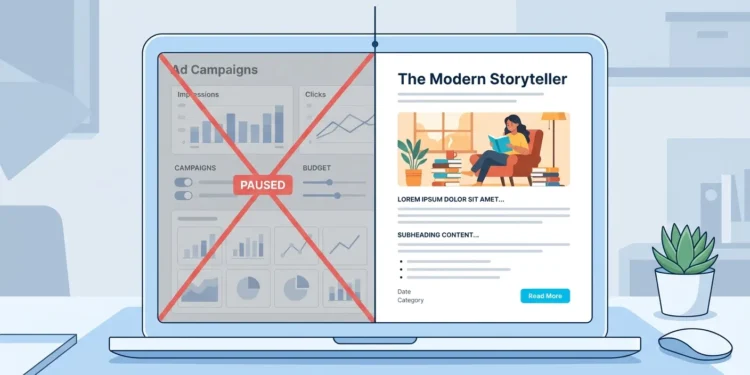
Short answer: Adstotally.com is a content site, not an advertising platform. Despite a name that sounds like an ad network or campaign manager, independent reviews that inspected the live site found no advertiser sign-up, no campaign builder, no targeting console, and no publisher payout system anywhere on it. What’s actually there is a general-interest blog publishing articles on technology, business, finance, health, travel, education, lifestyle and similar topics.
If you came here because you wanted to buy ads, you’re in the wrong place and should look at established networks instead. If you came because you read something on the site and wondered what it is, this guide covers what it publishes, who appears to run it, how it makes money, and how much weight its articles deserve.
Why the Name Creates So Much Confusion
The domain does a lot of damage to expectations before anyone reads a single article. “Ads” plus “totally” reads like a marketing product — a publisher monetization tool, a self-serve campaign dashboard, something with a login screen. Reviewers describe arriving with exactly that expectation and finding a blog instead.
Search results make it worse rather than better. Several explainer pages describe the domain using broad phrases like “digital marketing platform” or “advertising solution” while providing little evidence for those descriptions. At least one review claims the site connects advertisers with publishers and offers budget controls, targeting, reporting and payment features — claims no one has been able to verify against the live site.
So readers encounter a split: a name suggesting one thing, third-party pages asserting it, and an actual website doing something else entirely. That mismatch is the single most useful fact about this domain, and it’s worth understanding why it happens at all.
Where Those Misleading Descriptions Come From
Pages describing an unfamiliar domain as a “platform” or “solution” are often written for SEO rather than from inspection. A writer sees a domain with “ads” in it, assumes the obvious, and produces a confident-sounding explainer without ever visiting. Another writer reads that one and repeats it. The claim propagates without anyone checking.
That pattern isn’t unique to this domain. Any time you see several explainer articles about an unfamiliar website that contradict each other — and in this case reviewers noted that some third-party pages contradict even the site’s own about page — assume the ones with specific, checkable details are closer to reality than the ones full of generic feature lists.
What an Actual Ad Network Has That This Site Doesn’t
The clearest way to settle the question is to compare against what real advertising platforms require structurally. Networks like Google AdSense, Mediavine, and Ezoic all share a basic architecture:
| Feature | Real ad network | Adstotally.com (per site inspections) |
|---|---|---|
| Advertiser account/sign-up | Yes | None found |
| Campaign builder or targeting console | Yes | None found |
| Publisher payout system | Yes | None found |
| Reporting dashboard | Yes | None found |
| Published pricing or plans | Yes | None found |
| Named operating company | Yes | Not disclosed; WHOIS privacy-shielded |
Reviewers checking search results for the site as an “ad network” found pages praising its ease of use and support while showing no plan price, no company name, and no dashboard image. That absence is telling. A real platform has screenshots, pricing pages, and a terms-of-service document describing payment terms, because it has to.
Here’s the inversion that makes the naming so ironic: the site runs standard third-party display ads on its own pages, which makes it an ad consumer rather than an ad platform. It buys nothing and sells no inventory to outside publishers; it’s monetized the same way thousands of blogs are, by placing other networks’ ads on its own content.
One reviewer also reported seeing an outbound banner associated with troozon.com and some outbound links routed through a link-shortening service, openmylink.in. Link shorteners on outbound links are a normal monetization or tracking practice, but they do obscure where a click is actually going, which is worth knowing before you click.
What Adstotally.com Actually Publishes
The editorial range is wide. Across reviews, the recurring category list includes technology, business, finance, health, travel, education, lifestyle, entertainment, fashion, law and property. One reviewer summed up the subject mix as extremely broad, with a somewhat inconsistent editorial identity.
Breadth like that tells you something about the publishing model. A site covering law and fashion and cloud computing isn’t staffed by specialists in all three. It’s a general content hub, and the articles will read like competent generalist writing rather than expert analysis.
The Self-Referential Content Pattern
One detail multiple reviewers flagged independently is worth repeating, because it’s unusual. Several recent articles on the site are about the site itself, with titles along the lines of promoting it as a platform for content creators and bloggers. A large share of recent posts being self-promotional explainers about the domain rather than outside subjects is not how an ordinary publication behaves.
There’s a plausible explanation that doesn’t require assuming bad intent: a site positioning itself to attract guest-post submissions benefits from pages that rank for its own brand name and pitch itself to potential contributors. But it does mean that if you search the brand, some of what you find is the site marketing itself, not independent description.
Authorship and Transparency
Bylines appear thin. Reviewers noted posts credited to two different author names, one newer and one matching the brand, with a placeholder author in the sidebar — and no detailed credentials attached. Domain registration is privacy-shielded, so no operating company is publicly identifiable through WHOIS.
Anonymous publishing isn’t illegal or inherently suspicious; plenty of legitimate blogs run that way. It matters more here because the site publishes finance, health, law and cybersecurity content. Those are exactly the categories where Google’s own quality guidance puts the most weight on demonstrable experience and expertise, and where a reader has the most to lose from following weak advice.
Is Adstotally.com Legitimate and Safe to Visit?
Separate these two questions, because they have different answers.
Safe to visit: by the available evidence, yes. Reviews describe a real, actively maintained content site using standard security practices with the usual legal pages in place — and found no checkout, sign-up, or payment form anywhere on it. There’s nothing to pay for and no credentials to hand over, which removes the most common risk vectors. One reviewer concluded it is not a scam in any sense their review could confirm.
Reliable as a source: that’s a different bar, and the honest answer is “treat it as a general blog.” Reviewers consistently landed on the same framing — a working content website rather than an authoritative media publication, best approached as a general blog rather than a specialist source.
A practical safety note specific to this domain: because the site has no advertiser or publisher account system, any page claiming to be an Adstotally login, dashboard, or API portal should be treated as suspect. If a system doesn’t exist, a page offering to log you into it isn’t what it claims to be. Never enter credentials there.
The Guest Post and Backlink Angle
A chunk of the search traffic for this domain comes from SEO professionals, not readers, so it’s worth addressing directly.
Reviews describe the site as a general blog that sells guest posts, displaying characteristics associated with commercial guest-content websites. An SEO analysis estimated roughly 3,900 organic visits a month as of August 2026, with that traffic concentrated on the homepage and on branded keyword searches rather than spread across its article library.
That traffic shape matters more than the headline number. If visits cluster on the homepage and on people searching the brand name, the individual articles aren’t pulling meaningful search traffic of their own. For a marketer, the practical reading from one review was that the domain might serve for a low-risk brand mention or a controlled link test, but it isn’t a convincing traffic placement.
There’s also a risk worth naming plainly: paid links that pass ranking credit conflict with Google’s published spam policies on link schemes, regardless of which site hosts them. That’s a decision for whoever’s running the campaign, and anyone spending client money on link placements should weigh it against those policies rather than against a blog post’s verdict.
For ordinary readers, the guest-post model has a simpler implication. On sites that accept paid submissions, some articles exist because someone wanted a link published, not because an editor commissioned the topic. Read accordingly, especially when a piece steers hard toward one company.
How to Evaluate Any Domain Whose Name Doesn’t Match Its Function
The Adstotally.com situation isn’t rare. Domains get bought, repurposed, and renamed constantly, and a name is the least reliable signal about what a site does. A quick five-step check settles most cases in under ten minutes:
- Look for the functional proof. If a site claims to be a platform, find the login, the pricing page, the dashboard screenshots. Real products show them. Their absence is close to conclusive.
- Check who’s behind it. An About page with named people, a company name, and a physical address beats an anonymous byline. Run a WHOIS lookup; privacy shields are common but a shielded registration plus an anonymous About page is two blanks in a row.
- Read three articles, not one. Quality on general content sites varies more than on specialist publications. One good article doesn’t certify the rest.
- Notice what the site says about itself. A publication writing promotional articles about its own brand is doing marketing, not journalism. Weight those pages accordingly.
- Compare independent sources — and prefer specifics. When explainer pages disagree, the ones citing checkable details (what’s on the page, what the WHOIS says, what a named tool estimated) are more reliable than the ones listing generic features.
Applied to any unfamiliar domain, that routine catches both the harmless name mismatches and the genuinely sketchy ones.
The Bottom Line
Adstotally.com is a multi-topic content blog wearing an advertising platform’s name. There’s no campaign tool, no advertiser account, no publisher payouts — just articles across a dozen subjects, funded by display ads the site itself runs, with a guest-post pipeline supplying some of the content. Nothing in the available evidence suggests a scam; plenty suggests a generalist publisher rather than an authority.
Read it the way you’d read any anonymous general blog: fine for a casual explainer, not where you’d settle a question about your health, your taxes, or a legal deadline. For those, go to a specialist source or a qualified professional. And if you arrived looking for an advertising service, the established networks are the place to look instead.
FAQ
Is Adstotally.com an ad network?
No. Site inspections by independent reviewers found no advertiser sign-up, campaign builder, targeting tools, or publisher payout system. It runs third-party display ads on its own pages, making it an ad consumer rather than an ad platform.
Is Adstotally.com a scam?
No evidence supports that label. Reviewers found a real, actively maintained site with standard legal pages and no payment form, checkout, or credential request anywhere on it.
Who owns Adstotally.com?
It isn’t publicly disclosed. The domain registration is privacy-shielded, and articles carry minimal author information rather than named, credentialed bylines.
Can I buy a guest post or backlink there?
Reviews indicate the site sells guest posts. Before buying anywhere, weigh it against Google’s spam policies on link schemes — paid links intended to pass ranking credit conflict with those policies regardless of the host site.
Why do some websites describe it as a digital marketing platform?
Likely because the name implies it and some explainer articles were written without inspecting the site. Several third-party pages about the domain contradict each other, and at least one contradicts the site’s own about page.