


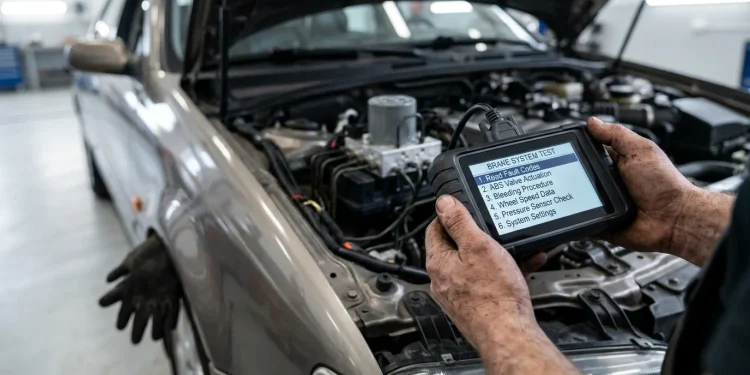
If you’ve run into the term “ABS Testauslösung” — in a German car manual, a VW or BMW forum thread, or a diagnostic scan tool — here’s the plain-English translation: it means ABS test activation, the deliberate triggering of the anti-lock braking system’s self-check or component test. It shows up in two very different situations. The first is automatic: your car briefly tests its own ABS hardware shortly after you start driving, which you may notice as a quick buzz, whir, or click. The second is manual: a technician (or a scan tool user) commands the ABS pump and valves to cycle on purpose, usually during diagnosis or brake bleeding.
Neither one means your brakes are failing. This guide explains both forms of ABS Testauslösung, what’s normal, what isn’t, and where the sensible line sits between DIY and a professional brake shop.
What Does ABS Testauslösung Actually Mean?
Break the word apart and it stops being intimidating. Test is test. Auslösung means “triggering” or “activation.” So ABS Testauslösung is simply the act of setting off an ABS test — whether the car does it by itself or a person does it through diagnostic equipment.
The term is German because that’s where much of the world’s ABS engineering vocabulary comes from. Bosch introduced the first mass-production electronic ABS in the late 1970s, German automakers adopted it early, and German-language service documentation followed the cars worldwide. American owners of VW, Audi, BMW, Mercedes, and Porsche vehicles run into untranslated terms like this constantly — in older service literature, in European diagnostic software, and in forum posts translated from German communities.
One clarification before going further: Testauslösung is not the same as the ABS engaging during an emergency stop. When you brake hard on a slick road and feel the pedal pushing back rapidly, that’s the system doing its real job. A test activation is a brief, controlled check that happens without any emergency at all.
The Automatic ABS Self-Test: The One Drivers Notice
Every modern ABS runs checks on itself, because the system has to preempt control of your brakes in an emergency and can’t afford to fail silently. These built-in self-diagnosis routines are, in fact, the only testing most ABS units ever receive after leaving the factory — the system checks itself and logs any problems to its fault memory rather than being periodically tested from outside.
The self-test happens in two stages.
Stage 1: The Electrical Check at Ignition
Turn the key (or press the start button) and the ABS control module immediately verifies its own electronics — the microprocessor, the wheel speed sensor circuits, the valve solenoids’ electrical continuity, and the warning lamp itself. That’s why the ABS light glows for a few seconds at startup and then goes out. The light turning off is the test passing. If the module finds a problem during these checks, it disables the ABS and leaves the warning light on to tell you service is needed.
At this stage nothing moves, so you won’t hear or feel anything beyond relays clicking in some cars.
Stage 2: The Functional Test Once You Start Rolling
Electrical checks can’t confirm that the hydraulic hardware physically works. So on many vehicles, the first time the car exceeds a low threshold speed after startup — commonly somewhere in the 4–20 mph range depending on the manufacturer — the control module briefly cycles the ABS pump motor and solenoid valves.
This is the Testauslösung drivers actually experience. Depending on the car, it can feel or sound like:
- A short mechanical buzz or whir from the engine bay or under the floor
- A single clunk or click shortly after pulling away
- A faint, momentary pulse in the brake pedal if your foot happens to be resting on it
- A quiet groan lasting under a second
It happens once per ignition cycle, at low speed, and then never again until the next restart. Many drivers go years without noticing it, then suddenly hear it in a quiet parking garage and assume something broke. Nothing did — the timing (just after startup, low speed, once only) is the giveaway that it’s the self-test.
Normal vs. Worth Investigating
| What you notice | Likely meaning |
|---|---|
| Brief buzz/click once, at low speed after startup, no warning lights | Normal self-test — no action needed |
| ABS light on for a few seconds at ignition, then off | Normal electrical check |
| ABS light stays on or comes on while driving | Fault detected; ABS is likely disabled — get it scanned |
| Pedal pulsation during normal gentle braking, repeatedly | Not a test — possible sensor, tone ring, or rotor issue |
| Pump running loudly or repeatedly during ordinary driving | Not normal — have the system inspected soon |
The key distinction: a test is brief, predictable, and silent about itself. Repeated or random activation is the system misreading wheel speeds, and the usual culprits are a failing wheel speed sensor, a corroded or damaged tone ring, or wiring trouble. In the US, rust-belt states see a lot of this — road salt eats sensor wiring and tone rings faster than almost anything else on the car.
Commanded Testauslösung: Triggering the Test With a Scan Tool
The second meaning of the term is the one technicians use daily. Modern diagnostic software can order the ABS module to activate its components on demand — cycle the pump, open and close individual solenoid valves, run an output check. In German-market software this function is often labeled Testauslösung or Stellglieddiagnose (actuator diagnosis); English-language tools call it an actuator test, function test, or output test.
Why would anyone trigger the ABS on purpose, with the car parked? Three common reasons:
1. Brake Bleeding After Hydraulic Work
This is the big one for DIYers. The ABS hydraulic unit contains valves and chambers that normal pedal-pumping can’t flush. If air gets into that unit — after replacing the unit itself, a master cylinder, or running the reservoir dry — conventional bleeding leaves air trapped inside, and the pedal stays spongy no matter how many times you bleed the corners.
The fix is a commanded bleed procedure: the scan tool triggers the pump and valves in a set sequence while you bleed, pushing trapped air out to the wheel circuits where it can escape. On VW and Audi vehicles this is a standard routine in tools like VCDS; most manufacturers have an equivalent, and many mid-range OBD-II scanners now include ABS bleed functions for common US-market brands. Skipping this step after opening the hydraulic unit is one of the most common causes of a mysteriously soft pedal.
2. Verifying a Repair
After replacing a pump, module, or valve block, cycling the components on command confirms the new parts respond before the car goes anywhere near a road test.
3. Isolating a Fault
If a stored trouble code points at, say, the left-front inlet valve, commanding just that valve tells the technician whether the valve itself is dead or the problem lives in wiring or the module. It separates “part failed” from “signal never arrived” — the distinction that prevents replacing expensive hydraulic units that were never broken.
If You’re Doing This Yourself, Know the Boundaries
A commanded Testauslösung is safe when done correctly, but a few rules are non-negotiable:
- Car secured, wheels chocked, transmission in park — some test routines check wheel speed sensors by expecting rotation; follow the tool’s instructions exactly.
- Battery on a maintainer. ABS pumps draw real current, and a voltage dip mid-procedure can abort the test or, on some modules, log new faults.
- Never run the pump dry. Keep the brake fluid reservoir topped up throughout any bleed procedure; letting it empty feeds air right back into the unit you’re trying to purge.
- Use the procedure for your exact vehicle. Sequences differ by manufacturer, model, and even model year. The generic steps in a scanner menu are not a substitute for the factory procedure.
- Test the pedal before driving. Firm pedal at standstill, then a careful low-speed stop in a safe area, before any normal driving.
And the honest YMYL caveat: brakes are not the system to learn on. If any of the above reads as unfamiliar, a brake shop will perform the commanded bleed or actuator test quickly and relatively cheaply, and you get a verified pedal out of it. No article — this one included — should be your only source for safety-critical brake work; the factory service information for your specific vehicle is the authority.
Why an ABS Test Can Trigger Unexpectedly
A few situations make the system activate when drivers don’t expect it, and they’re worth separating from true faults:
- Gravel, snow, or washboard roads at low speed. Loose surfaces let wheels momentarily slip, and ABS intervention during gentle braking on gravel is normal behavior, not a malfunction. Stopping distances on loose gravel can actually lengthen with ABS — the trade-off for maintaining steering control.
- After a battery disconnect. Some vehicles run a fuller self-check on the first drive cycle after power loss, so the startup noise may be slightly more noticeable once.
- Mismatched tire sizes or a compact spare. A wheel rolling at a different speed than its siblings looks like slip to the control module. With a temporary spare fitted, occasional ABS activity or a lit warning light is common and resolves when the full-size tire returns.
- A failing sensor on the edge. Intermittent sensor dropout can cause brief, random pump activity before a hard fault code ever sets. If the startup “self-test noise” seems to happen while driving, not just after startup, that’s the pattern to take seriously.
ABS Testauslösung and US Vehicle Inspections
One more practical note for American readers. Unlike Germany’s TÜV inspections, most US states don’t functionally test ABS operation during safety inspections — where brake checks exist at all, they generally cover braking performance and the warning lamp. The practical consequence: your car’s own self-test is usually the only ABS check it ever gets, which is exactly why an illuminated ABS light shouldn’t be ignored for months. The car has already run the test, failed it, and shut the system off; your regular brakes still work, but the anti-lock function is gone until the fault is fixed. Requirements vary by state, so check your state’s inspection rules if you’re unsure what’s covered.
The Bottom Line
ABS Testauslösung is a German label for something refreshingly undramatic: the triggering of an ABS test. When your car does it automatically — a one-time buzz or click at low speed after startup — it’s the system proving its pump and valves still answer, and it needs nothing from you. When a person does it through a scan tool, it’s a legitimate service function used for bleeding brakes after hydraulic work, verifying repairs, and pinpointing faults.
The working rule to take away: once, briefly, after startup is a test; repeatedly, randomly, or with a warning light is a fault. For the first, drive on. For the second, have the system scanned promptly — and for anything involving opening the hydraulic system, weigh honestly whether a professional’s hour costs less than the risk of getting a brake repair wrong.
FAQ
Is the buzzing noise after I start driving my car normal?
If it’s a brief buzz, whir, or click that happens once at low speed shortly after startup, with no warning lights, that’s the ABS self-test and it’s completely normal. Many cars do it every single drive cycle.
What does Testauslösung mean in my scan tool?
It’s German for “test activation” — the function that commands the ABS pump and valves to cycle for diagnosis or brake bleeding. English-language tools label the same thing “actuator test” or “ABS bleed/function test.”
Can I drive with the ABS warning light on?
Generally the conventional brakes still work, but the anti-lock function is disabled, so the car can lock wheels in a hard stop. Treat it as a repair to schedule promptly, not an emergency stop on the shoulder — unless the red brake warning light is on too, which can indicate a hydraulic problem and does warrant stopping safely and getting the car checked before driving on.
Why does my ABS kick in on gravel roads?
Loose surfaces let wheels briefly slip under braking, which the system reads as lockup. Activation on gravel or snow at low speed is normal ABS behavior, not a test and not a fault.
Do I need a special tool to trigger an ABS test myself?
Yes — a scanner with ABS/actuator support for your vehicle brand. Basic code readers that only handle engine codes can’t command the ABS module. For brand-specific routines (VW/Audi, for example), enthusiast tools like VCDS or a shop-grade scanner are the usual options.