


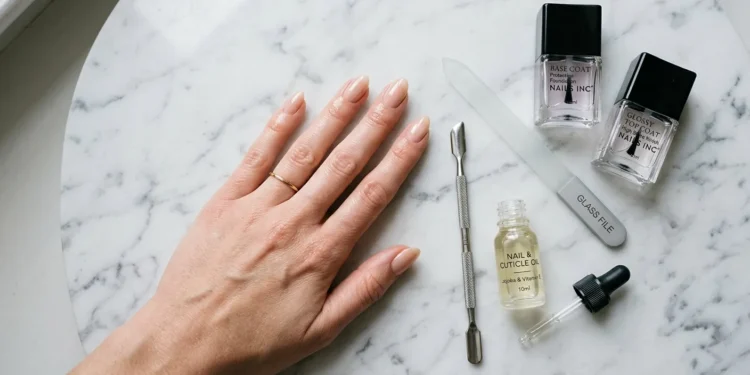
You can get a clean, long-lasting dry manicure at home — smoother polish, tidier edges, and color that doesn’t peel in two days — by prepping your nails without soaking them and pushing back (not cutting into) your cuticles. What you can’t safely do at home is a true Russian manicure, the deep dry-cuticle technique that relies on a professional e-file and real training. This guide covers both: the salon-quality dry manicure you can do yourself tonight, and an honest look at what the Russian method is, why it lasts so long, and why the authentic version belongs in a trained tech’s chair.
If you came here hoping to DIY the full Russian technique, read the safety section first. It’ll save you a cut cuticle or worse.
What “Dry Manicure” Actually Means
A dry manicure is exactly what it sounds like: you prep the nails without the warm-water soak that starts most traditional manicures. Everything — cuticle work, shaping, polish — happens on dry nails.
That one change matters more than it sounds. Soaking makes the nail plate swell and absorb water. You polish, the nail slowly returns to its normal size over the next day, and the polish loses its grip and chips early. Skip the soak and the nail stays its true shape, so color adheres better and lasts noticeably longer. This is why most gel applications are done dry, and why the dry method has become the standard for durability.
Dry vs. Traditional (Wet) Manicure
| Dry manicure | Traditional wet manicure | |
|---|---|---|
| Cuticle prep | Push back on dry skin, often with remover | Soak in warm water first |
| Polish longevity | Longer; nail stays its real shape | Shorter; nail shrinks after drying |
| Best for | Gel, longer wear, precise edges | Quick classic polish, a relaxing feel |
| Cuticle risk | Lower if you push, don’t cut | Soft skin can tempt over-trimming |
What Is a Russian Manicure, Exactly?
Here’s where terms get muddled online. A Russian manicure (sometimes called a dry or e-file manicure) is a specific, advanced version of the dry method. Instead of just pushing cuticles back, the technician uses a small electric file (an e-file) with specialized bits to remove the thin layer of dead skin tucked right under and around the cuticle, getting extremely close to the nail fold.
That deep cleanup is what creates the look people chase: polish or gel applied so close to the base that the manicure looks flawless for weeks and grows out far less obviously. It’s popular for a reason. The results are genuinely cleaner and longer-lasting than a standard manicure.
But the technique that makes it special is also what makes it risky. Working that close to the nail fold with a rotating bit is a precision skill, and that’s the whole catch.
Why You Shouldn’t Fully DIY a Russian Manicure
This is the part a lot of trendy how-to posts skip, and it matters.
The area a Russian manicure targets — the seal where skin meets nail — exists to keep bacteria and fungus out. Dermatologists and nail-health guidance consistently warn against aggressive cuticle removal for exactly this reason: cut or over-file that seal and you open a door for infection. The American Academy of Dermatology has long advised leaving cuticles alone rather than cutting them, because they protect the skin barrier around the nail.
Stack on the specific hazards of doing it yourself:
- E-file injuries. A rotating bit in untrained hands can file the natural nail too thin, burn the skin from friction, or nick the nail fold. Pros train specifically to avoid this.
- Infection risk. Breaking that seal, especially with tools that aren’t properly sterilized, can lead to painful infections around the nail (paronychia).
- Over-thinning. Removing too much from the nail plate leaves it weak, bendy, and prone to breaking for months.
None of this means you can’t get a great dry manicure at home. It means the deep e-file cuticle work is the one step to leave to a licensed professional. Everything else is fair game.
How to Do a Safe, Salon-Quality Dry Manicure at Home
This gives you most of the polish and longevity benefits without touching the risky part. Set aside about 45 minutes and work one hand at a time.
What You’ll Need
- Nail clippers and a glass or fine-grit file
- A cuticle pusher (a rubber-tipped or metal one; wooden orangewood sticks also work)
- Cuticle remover (a gentle exfoliating liquid or gel)
- A buffer
- Lint-free wipes and 70%+ isopropyl alcohol (or acetone)
- Base coat, your color, top coat — or a gel setup with an LED lamp if you go gel
- Cuticle oil and hand cream
Step by Step
- Start completely dry and clean. No soak. Wash and fully dry your hands. Remove any old polish.
- Shape first. Clip if needed, then file in one direction to your chosen shape. Doing this before anything else keeps the free edge clean.
- Apply cuticle remover. Put a small amount along each cuticle line and give it 30–60 seconds to soften the dead skin. This chemical step replaces the aggressive physical work of the salon version.
- Gently push back — don’t cut. Use the pusher to ease the cuticle back off the nail plate. Push, don’t dig. Resist the urge to trim living skin; a hangnail can be snipped, the cuticle itself should stay.
- Buff lightly. A few passes to knock down shine and smooth ridges. Don’t thin the nail.
- Dehydrate the nail. Wipe each nail with alcohol or acetone on a lint-free pad. This removes oil and dust, and it’s the single most skipped step that ruins longevity.
- Base, color, top. Thin coats beat thick ones every time. Two thin color coats will outlast one gloppy one. Cap the free edge (swipe the brush along the tip) to seal against chipping. For gel, cure each layer per your lamp’s instructions.
- Oil and moisturize — after everything’s dry or cured. Cuticle oil plus hand cream restores the skin you just worked on.
The Mistakes That Wreck a Home Manicure
- Skipping the dehydration wipe. Oil left on the nail is the number-one cause of early peeling.
- Flooding the cuticles with polish. Leave a hair’s gap at the base; polish on skin lifts and takes the whole edge with it.
- Thick coats. They stay gummy, dent easily, and chip as a sheet.
- Cutting cuticles to “get that salon look.” This is the home version of the Russian-manicure risk. Push, don’t cut.
When to Just Book the Salon
If the genuine Russian-manicure finish is what you want — that grown-out-proof, two-to-four-week flawless base — see a licensed tech who’s specifically trained in the e-file method. It’s worth vetting the salon: ask whether tools are sterilized in an autoclave or single-use, and whether the tech is trained on the Russian/e-file technique specifically. A good one will happily tell you.
Think of it as the split that keeps your nails healthy: the weekly dry manicure you maintain at home, and the occasional professional e-file manicure for special occasions or when you want the longest wear. You get salon-level results without turning a rotary tool on your own cuticles.
The Bottom Line
A salon-perfect dry manicure at home comes down to a few disciplined habits: skip the soak, soften cuticles chemically and push them back instead of cutting, dehydrate before polish, and keep every coat thin. That alone gets you most of the longevity people associate with a Russian manicure. The deep e-file cuticle work that defines the real thing is the one piece to leave to a trained professional — your nail health is worth more than squeezing the full technique into a DIY session. Start with the safe version this week, and book a pro when you want the showpiece.
FAQ
Is a dry manicure the same as a Russian manicure?
Not quite. All Russian manicures are dry, but not all dry manicures are Russian. A dry manicure just skips the water soak; the Russian version adds deep e-file cuticle work that requires professional training.
Can I do a Russian manicure at home safely?
The full technique, no — it uses an electric file very close to the nail fold, where mistakes cause cuts, burns, over-thinning, or infection. You can get most of the look safely by doing a careful dry manicure and pushing (not cutting) your cuticles.
Why does a dry manicure last longer than a regular one?
Soaking swells the nail; as it dries over the next day it shrinks back and loosens the polish. A dry nail keeps its true shape, so color grips better and chips later.
Is it bad to cut your cuticles?
Dermatology guidance generally advises against it. Cuticles seal out bacteria and fungus, so cutting them raises infection risk. Softening and pushing them back is the safer way to get a clean look.
How often should I do a dry manicure?
Roughly once a week for upkeep works for most people, with cuticle oil in between. Over-prepping the same nails more often can stress the nail plate.