

Here’s the part most guides won’t say plainly: the barcode on a perfume box cannot prove the bottle inside is authentic. Counterfeiters copy barcodes the same way they copy logos, and a scanned fake will often return the real product’s name. What the código de barras can do is fail — and those failures are useful. A number that doesn’t match between box and bottle, a code printed in the wrong place, a sticker slapped over the original, or a number that doesn’t pass its own math check are all strong signals something’s wrong.
This guide shows exactly which barcode checks are worth your time, which popular “trick” is a myth, and how to combine the barcode with the batch code and physical details to make a real judgment about a bottle.
What the Código de Barras on a Perfume Box Actually Is
The stripes and digits on the bottom of the box are a GS1 barcode, usually an EAN-13 (13 digits, standard in Mexico, Europe and most of the world) or a UPC-A (12 digits, common on products sold into the United States). The number itself is called a GTIN — a Global Trade Item Number.
Its job is boring and specific: identify a product variant so a register knows what rang up. The GTIN says “Brand X, Fragrance Y, 100 ml eau de parfum.” That’s it. It carries no manufacturing date, no quality certification, and no anti-counterfeiting signature.
Two things follow from that, and both matter:
- A genuine barcode on a box proves the number is genuine, not the liquid inside.
- A barcode that’s wrong in some way was handled by someone careless — and careless handling is exactly what you find in counterfeit supply chains.
So you’re not verifying authenticity. You’re hunting for mistakes.
The Myth You Should Stop Repeating: Barcode “Country Codes”
This one circulates constantly in perfume groups and on TikTok: check the first three digits, and if they don’t match the brand’s home country, the perfume is fake. A French brand should start with 30–37, the logic goes, so a Chanel box starting with 690 must be counterfeit.
It isn’t true, and GS1 — the organization that actually issues these numbers — says so directly. According to GS1’s own FAQ on barcode prefixes, the GS1 prefix does not show the country of origin, and the product may have been produced anywhere in the world.
What the prefix really indicates is which GS1 member organization licensed the number to the company. A brand headquartered in France that registered through GS1 US will carry a US-range prefix on products manufactured in Spain. Fact-checkers have debunked this repeatedly — the same myth has been used to accuse products of being made in China, Russia and Israel based on nothing but a prefix.
Why this matters for perfume specifically: a legitimate bottle bought in Mexico may well carry a different prefix than the same fragrance bought in the US, because regional distributors sometimes register their own GTINs. Judging authenticity on the prefix will make you reject real bottles and accept fakes. Drop the trick entirely.
Four Barcode Checks That Are Actually Worth Doing
With the myth cleared away, here’s what genuinely helps.
1. Match the Box to the Bottle
The most reliable barcode-related check isn’t about the barcode alone. On genuine packaging, the identifying codes on the carton and on the bottle correspond — most guides emphasize comparing the serial or batch number printed on the box bottom against the one on the bottle, and treating a mismatch as a strong fake signal.
Counterfeit operations mass-produce boxes and bottles on separate lines and pair them at random, so mismatches are common. Pick up both, read both, compare character by character. A difference of one digit matters.
2. Look at Where the Code Sits and How It’s Printed
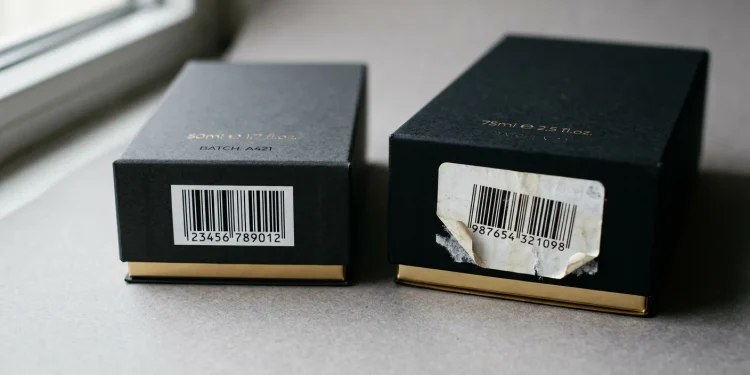
On authentic perfume cartons, the barcode is typically printed on the lower back or the bottom of the box, not on the sides. Packaging guides consistently flag misplaced or blurry barcodes as red flags, along with codes that appear on a cheap stick-on label rather than being printed into the carton itself.
Specific things to look at:
- Print quality. Genuine cartons use crisp, high-resolution printing. Fuzzy bars with bleeding edges suggest a scanned-and-reprinted copy.
- Stickers over print. A barcode label pasted over another barcode is sometimes legitimate (importers relabel for local markets), but combined with any other red flag it’s a serious concern. Peel gently at a corner if the item is yours: what’s underneath?
- Alignment. Mass-produced authentic packaging prints straight. Noticeably crooked codes point to small-batch production.
3. Run the Check-Digit Math
Here’s a test almost nobody mentions, and it costs you one minute. Every EAN-13 and UPC barcode ends with a check digit calculated from the digits before it. If the number was invented rather than issued, the math usually fails.
For a 13-digit EAN, counting positions from the left:
- Add the digits in positions 1, 3, 5, 7, 9 and 11.
- Add the digits in positions 2, 4, 6, 8, 10 and 12, then multiply that total by 3.
- Add the two results.
- The check digit (position 13) is whatever brings the total up to the next multiple of 10.
Worked example using a made-up number, 8400001234565:
- Odd positions: 8+0+0+1+3+5 = 17
- Even positions: 4+0+0+2+4+6 = 16, times 3 = 48
- Total: 17 + 48 = 65
- Next multiple of 10 is 70, so the check digit must be 5 — which matches the final digit. The number is structurally valid.
What this tells you: a failed check means the barcode is fabricated, full stop. A passed check means only that the number is well-formed — copied barcodes pass too, because they’re real numbers. It’s a one-way test, but it catches the laziest fakes instantly.
4. Scan It and See What Comes Back
Scan the code with any barcode app or your phone’s camera and compare what returns against the box in your hand. You can also look up the number through GS1’s own verification service, which shows which company licensed that GTIN.
Three outcomes and what they mean:
| Result | What to make of it |
|---|---|
| Returns the exact product, brand and size on the box | Neutral. The number is real; the bottle still might not be. |
| Returns a different product, size or brand | Serious red flag. Investigate everything else. |
| Returns nothing | Mildly suspicious, not conclusive. Databases miss regional and newer products constantly. |
That middle row is where the barcode earns its keep. A 100 ml box whose code resolves to a 50 ml listing, or a women’s fragrance whose code returns a men’s version, points to recycled packaging artwork.
Barcode vs. Código de Lote: Two Different Things
A lot of confusion comes from treating these as interchangeable. They aren’t, and the batch code is arguably the more informative of the two.
| Barcode (código de barras) | Batch code (código de lote) | |
|---|---|---|
| Looks like | Stripes + 12–13 digits | Short alphanumeric string, often 5–7 characters |
| Where | Printed on the carton, lower back or bottom | Etched or stamped on the bottle base and printed on the box |
| Identifies | The product model | The specific production run |
| Tells you | What it claims to be | Roughly when it was made |
The batch code is usually laser-etched into the glass or ink-stamped on the bottom of the bottle, with the matching code on the carton. Free lookup tools like CheckFresh and CheckCosmetic decode many brands’ batch formats into an approximate production date.
Two practical uses:
- Consistency. The batch code on the bottle should match the one on the box. A mismatch is one of the most-cited counterfeit indicators.
- Plausibility. If a lookup returns a production date years before the fragrance was launched, or the tool can’t parse the format at all for a brand it normally handles, something’s off.
Caveat worth stating: these decoders are community-maintained and unofficial. They cover common brands well and obscure ones poorly, and a code they can’t read isn’t proof of anything. Treat them as one input, never a verdict.
What the Barcode Will Never Catch
The best counterfeits now copy packaging convincingly, barcode included. These checks live outside the code entirely, and honestly they catch more fakes than the barcode ever will.
Price. The single strongest signal. A fragrance that retails around $150 being offered at $30 is almost certainly not a discounted original — legitimate markdowns on current luxury fragrances rarely run deeper than roughly 20–40%, and then usually through gray-market retailers, not street vendors.
Cellophane and seals. Authentic boxes are machine-sealed tightly. Loose, wrinkled, hand-folded or re-glued cellophane is a classic warning sign. Counterfeit wrapping is often noticeably thicker and baggier.
Glass and cap. Genuine bottles use precisely molded glass with a cap that seats cleanly and no glue residue around the collar. Fakes commonly show uneven glass, bubbles, loose atomizers and crooked labels.
The liquid. Color that’s far too pale or oddly dark is a warning sign. Authentic juice is clear, with no sediment or floating particles.
The scent and how it behaves. Counterfeits typically open with a harsh alcohol blast and collapse within an hour or two, where the original develops through its stages and lasts. If you own a known-genuine bottle, compare on skin, not paper.
The seller. Street markets, social media sellers, pop-up stalls and unfamiliar websites are the main channels for fakes. Authorized retailers, department stores and the brand’s own site are where authenticity is easiest to establish — and where returns actually work.
A 7-Minute Check Before You Buy or After You Open
Do these in order. Most fakes fail before step 5.
- Price sanity check. Compare against the brand’s official site or a major authorized retailer in your country. Too cheap ends the exercise.
- Inspect the cellophane. Tight and machine-sealed, or loose and hand-wrapped?
- Find the barcode. Lower back or bottom of the box, printed crisply into the carton, not on a stuck-on label.
- Run the check digit. One minute of arithmetic rules out fabricated numbers.
- Scan it. Does the result match the brand, fragrance and size on the box?
- Open and compare codes. Batch code on the bottle base versus the one on the box — they should match. Run it through a batch decoder if your brand is supported.
- Examine the bottle. Glass quality, cap fit, label alignment, liquid clarity, and the scent’s behavior over an hour.
If steps 1, 2 and 6 all pass and the bottle looks right, you’re in reasonable shape. Any two failures together, and I’d return it.
If You Think You Bought a Fake
Stop using it on your skin. Counterfeit fragrances are produced outside any regulatory oversight, and testing by enforcement agencies has found contents that pose genuine safety risks — UK Trading Standards, for example, reported seized counterfeit perfumes containing excessive methanol, which also makes them more flammable. Reported reactions range from contact dermatitis to rashes and irritation. If you develop a skin reaction or any symptom that concerns you, see a doctor or dermatologist rather than self-treating based on a blog post.
Document before you complain. Photograph the box, the bottle, both codes, the listing or receipt, and the seller’s details.
Start with the seller or platform. Marketplaces, credit card issuers and PayPal all have dispute processes for items not as described, and counterfeit claims are usually well covered. Open the case quickly — most have deadlines.
Report it. In Mexico, consumer complaints go through Profeco, the federal consumer protection agency. In the United States, counterfeit goods can be reported to the FTC and to the National IPR Center, and major brands run their own anti-counterfeiting contact channels. Rules, forms and deadlines differ by country and change over time, so check the current official guidance for your jurisdiction. For anything involving significant money, a consumer-law professional is the right call.
The Takeaway
A codigo de barras perfume check is a screening tool, not a verdict. Used properly it rules things out fast: fabricated numbers fail the check digit, mismatched box-and-bottle codes expose random pairing, and a code on the side of a box or on a cheap sticker tells you the packaging wasn’t made by the brand. What it can never do is confirm a bottle is genuine, because the number itself is trivially copyable — and the country-prefix trick so many people rely on doesn’t work at all.
The strongest protection isn’t a code on a box. It’s buying from an authorized seller at a believable price, then using the barcode, batch code and physical details as confirmation rather than as a rescue plan.
FAQ
Can a barcode prove a perfume is original?
No. Counterfeiters copy real barcodes, so a code that scans correctly proves only that the number exists. Barcodes are useful for catching errors — mismatches, bad placement, failed check digits — not for confirming authenticity.
Do the first digits of the barcode show where the perfume was made?
No. GS1 states that the prefix does not indicate country of origin; it identifies the GS1 member organization that licensed the number. The product can be manufactured anywhere, so a “wrong” prefix is not evidence of a fake.
Where should the barcode be on a genuine perfume box?
Typically printed into the lower back or bottom of the carton, crisp and straight. Codes on the sides, blurry printing, or barcodes on cheap stick-on labels are commonly cited warning signs.
What’s the difference between the barcode and the código de lote?
The barcode identifies the product model; the batch code identifies the production run and can often be decoded into an approximate manufacturing date. The batch code should match between the bottle base and the box.
Is it dangerous to use a counterfeit perfume?
Potentially. Fakes are made without regulatory oversight, and seizures have turned up harmful substances including excessive methanol, with reported reactions such as skin irritation and dermatitis. Stop using the product and consult a healthcare professional if you have any reaction.