

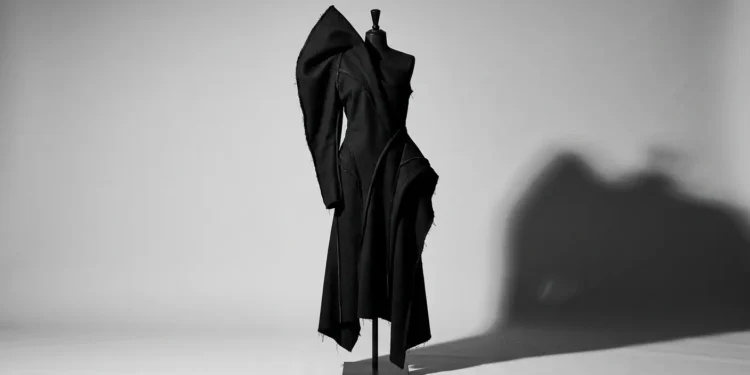
Avant garde fashion is clothing designed to challenge what clothing is supposed to be. Instead of flattering the body or following a season’s trends, it questions proportion, construction, gender, beauty, and sometimes the idea of wearability itself. A Comme des Garçons dress with padded lumps across the back, a Paco Rabanne dress built from linked metal discs, a Hussein Chalayan skirt that converts into a coffee table — all of it qualifies, and none of it is trying to sell you a work outfit.
The term is French, borrowed from the military. Avant-garde meant the advance guard, the unit that moved ahead of the main army. In fashion, it describes designers working ahead of what the market is ready for. Which raises the harder question most explainers skip: how do you tell genuine avant-garde work from clothes that are just odd?
What Avant-Garde Fashion Actually Means
Three things separate avant-garde design from ordinary fashion.
It starts from an idea, not a customer. A commercial designer asks what will sell next spring. An avant-garde designer asks a question — what if a garment had no front or back? what if beauty didn’t require symmetry? — and lets the answer determine the clothes. Commercial viability is a consequence at best, and frequently not a consideration at all.
It treats the body as a subject, not a mannequin. Mainstream clothing accepts the human silhouette and decorates it. Avant-garde work reshapes it, obscures it, extends it, or argues with it. Rei Kawakubo’s spring 1997 Comme des Garçons collection, widely known as “Body Meets Dress, Dress Meets Body,” inserted down-filled pads into dresses in places no fashion designer had ever put volume. The press nicknamed it “lumps and bumps.” It’s now studied in museum exhibitions.
It expects resistance. Work that everyone likes immediately isn’t ahead of anything. Most of the pieces now considered landmarks were ridiculed when they appeared. That reaction is almost a defining feature.
Note the spelling, since both forms show up constantly: avant-garde fashion with the hyphen is the standard in formal writing, while avant garde fashion without it is common online. They mean exactly the same thing.
How to Tell Avant-Garde From Just Strange
Plenty of clothing is unusual without being avant-garde. A viral red-carpet dress made of raw meat, a costume-shop cape, a brand’s deliberately absurd item engineered for social media — these borrow the look without the substance. Four questions usually sort it out.
- Is there an argument underneath? Avant-garde pieces carry a proposition about bodies, culture, labor, or clothing itself. Martin Margiela’s exposed seams and visible linings argued that the hidden work of garment construction deserved to be seen. Strip the idea away and you’ve got a shock image, not a design position.
- Is the craftsmanship real? Deconstruction only reads as deconstruction if the maker demonstrably knows how to construct. Sloppy work that looks unfinished isn’t the same as finished work that deliberately shows its process.
- Does it belong to a body of work? Designers in this tradition pursue the same questions across decades. A one-off stunt from a brand that otherwise sells basics is marketing.
- Does it influence anything? Ideas that matter get absorbed. Oversized shoulders, raw hems, asymmetric hemlines, and gender-neutral tailoring all reached mall racks from avant-garde runways years earlier.
That last test takes time to apply, which is why some contemporary work can’t be judged yet. Say so rather than guessing.
A Short History of Avant-Garde Fashion
Early 20th Century: Art Movements Reach the Body
The roots sit in the art world. Surrealism, Dada, Cubism, and Futurism were already dismantling representation when designers started borrowing the logic. Elsa Schiaparelli collaborated directly with Salvador Dalí in the 1930s on pieces including the Lobster Dress and the Shoe Hat — garments that functioned as surrealist objects while remaining technically wearable. Earlier, Paul Poiret had freed the waist from the corset, a structural rethinking that mattered more than any single dress.
1960s: Space Age and Industrial Materials
Postwar optimism and the space race produced a generation experimenting with materials that had nothing to do with traditional dressmaking. André Courrèges and Pierre Cardin built geometric, architectural silhouettes. Paco Rabanne presented a collection of dresses assembled from plastic and metal plates linked with rings, famously framing them as unwearable dresses — clothing made with pliers rather than needles.
1980s: The Japanese Wave
The decisive rupture came when Rei Kawakubo of Comme des Garçons and Yohji Yamamoto showed in Paris in the early 1980s. Their collections were black, oversized, asymmetric, distressed, and almost entirely indifferent to the Western conventions of a fitted, flattering silhouette. European critics were hostile, and some coverage used language about the clothes that looks indefensible in retrospect.
Fashion history treats that moment as a hinge. Issey Miyake, working alongside them, spent decades on pleating technology that merged engineering with garment-making. Together they established that clothing could be conceptual without being costume.
1990s: Deconstruction and the Antwerp Generation
Belgian designers took the thread further. Martin Margiela turned linings outward, exposed basting stitches, reassembled vintage garments into new ones, and removed his own name from the label — replacing it with a blank white tag. Six graduates of Antwerp’s Royal Academy, later nicknamed the Antwerp Six, pushed conceptual, narrative-driven design into the European mainstream. Margiela’s split-toe Tabi boot, introduced in his first collection in the late 1980s, remains one of the most recognizable avant-garde objects in fashion.
2000s to Now: Spectacle and Technology
Alexander McQueen fused tailoring skill with theatrical presentation; his spring 2010 collection introduced the towering Armadillo shoe and digitally printed, reptilian silhouettes. Hussein Chalayan built collections around transforming furniture and remote-controlled garments. Iris van Herpen brought 3D printing and material science into couture.
Today the field is quieter and more diffuse. Rick Owens has built a durable commercial business on a consistently dark, sculptural vocabulary. Independent and student designers keep producing work that outruns the market. If you want to see where the next generation is headed, fashion school graduate collections and smaller international shows are more useful than the major fashion weeks.
Designers Worth Knowing
| Designer / House | Known for | Signature piece or moment |
|---|---|---|
| Rei Kawakubo (Comme des Garçons) | Reshaping the body, “anti-fashion” | “Lumps and bumps” collection, spring 1997 |
| Yohji Yamamoto | Oversized, draped, predominantly black tailoring | Early-1980s Paris collections |
| Issey Miyake | Pleating technology, garment engineering | Pleats Please line |
| Martin Margiela | Deconstruction, anonymity, reconstruction | Split-toe Tabi boot; blank white label |
| Alexander McQueen | Theatrical shows, extreme silhouettes | Armadillo shoe, spring 2010 |
| Iris van Herpen | 3D printing, material experimentation | Laser-cut and printed couture dresses |
| Rick Owens | Monochrome, sculptural, draped daywear | Elongated sneakers and drape-heavy layering |
| Vivienne Westwood | Punk as fashion, historical subversion | Early punk-era designs with Malcolm McLaren |
The Techniques That Define the Look
Avant-garde work tends to use a recognizable set of methods, and once you know them, the clothes become much easier to read.
- Deconstruction. Taking garments apart and leaving the evidence visible — raw edges, exposed seams, inside-out linings, unfinished hems.
- Sculptural volume. Padding, boning, wiring, or layering that creates shapes the body doesn’t have on its own.
- Unconventional materials. Metal, plastic, paper, rubber, recycled industrial waste, printed polymers. Material choice is often the whole argument.
- Asymmetry and anti-fit. One sleeve, uneven hems, garments that hang rather than conform.
- Gender fluidity. Skirts on men, suiting on women, and cuts that simply ignore the question — a position avant-garde design held decades before it reached mainstream retail.
- Monochrome restraint. Especially in the Japanese and Belgian traditions, black dominates. Removing color pushes attention to shape and texture.
Avant-Garde vs Haute Couture vs High Fashion
These three get used interchangeably online, and they shouldn’t be.
| Avant-garde | Haute couture | High fashion (ready-to-wear) | |
|---|---|---|---|
| Primary goal | Explore an idea | Execute craftsmanship at the highest level | Sell desirable clothing at scale |
| Defined by | Conceptual position | Legally protected French designation with strict criteria | Market tier and price point |
| Wearability | Often irrelevant to the design | Wearable, made to measure | Designed to be worn daily |
| Typical buyer | Collectors, museums, a small cult audience | A very small group of private clients | Department stores, boutiques, online retail |
Couture and avant-garde overlap — Iris van Herpen does both — but they answer different questions. Couture asks how beautifully something can be made; avant-garde asks what it should be in the first place. And “costume,” worth adding, differs from all three: a costume represents a character, while avant-garde clothing represents an idea.
How Runway Ideas End Up in Your Closet
This is the part most readers underestimate. Almost nothing on an experimental runway sells, yet the ideas migrate reliably, usually on a five-to-fifteen-year lag.
The path looks like this: a conceptual designer introduces a shape or method → fashion editors and stylists circulate the images → other designers absorb the vocabulary → contemporary brands soften it → mass retailers produce an accessible version.
Concrete examples of that pipeline:
- Oversized, dropped-shoulder silhouettes moved from early-1980s Japanese collections into standard streetwear decades later.
- Raw hems and visible seams, once the shocking signature of 1990s deconstruction, became a routine denim finish.
- Chunky, exaggerated sneaker proportions traced back to avant-garde houses before dominating mainstream footwear.
- Gender-neutral sizing moved from conceptual runways to major retailers’ product categories.
So the practical answer to “why should I care about clothes nobody wears?” is that you’re already wearing a diluted version of them. For a broader view of how runway ideas filter into what people actually buy, see our guide to how fashion trends start and spread.
Can You Actually Wear Avant-Garde Fashion?
Yes, with calibration. The all-or-nothing version — head-to-toe conceptual layering — reads as costume in most American settings outside creative industries, major-city nightlife, and fashion events. A more workable approach:
Start with one piece. A single sculptural coat, an asymmetric top, or genuinely unusual footwear anchored by plain basics. The contrast is what makes the piece read as intentional rather than confused.
Keep the palette tight. Black, charcoal, bone, rust. Monochrome lets unusual shapes register as design instead of chaos.
Fit the things that should fit. If the top is voluminous, the bottom should be lean, and vice versa. Volume everywhere usually just looks like ill-fitting clothing.
Buy secondhand first. Archive resale platforms, consignment shops, and estate sales are how most people enter this category without four-figure spending. Japanese and Belgian labels circulate heavily on the secondary market.
Try the silhouette before the label. Thrifted oversized blazers and asymmetric pieces from inexpensive brands let you learn what proportions suit you before investing. If you’re building a wardrobe around fewer, better pieces, our notes on buying quality clothing that lasts pair well with this approach.
Common mistakes: confusing “expensive and weird” with avant-garde, buying a famous piece you don’t actually like because it signals taste, and ignoring whether a garment works with the life you have. The tradition is about questioning conventions, not obeying a different set of them.
Where to See the Real Thing
Museum collections are the best free education available. The Metropolitan Museum of Art’s Costume Institute holds significant holdings of conceptual designers and mounted a major Rei Kawakubo retrospective in 2017 — only the second exhibition the institute has devoted to a living designer. London’s Victoria and Albert Museum maintains an extensive fashion collection with searchable records. For the term’s broader art-historical meaning beyond clothing, Britannica’s entry on avant-garde is a reliable starting point.
Exhibition schedules change constantly, so check current listings before planning a visit around any specific show.
The Takeaway
Avant garde fashion isn’t a style you buy; it’s a position designers take — clothing used to ask questions rather than answer market demand. The pieces that look absurd in photographs are usually the ones doing the most work, and the proof shows up years later in ordinary wardrobes, in a hemline, a shoulder, a seam left visible.
If you want to go further, pick one designer from the table above and spend an hour with their archive. Pattern recognition builds fast, and the clothes stop looking random once you can see the argument running through them.
FAQ
What’s the difference between avant-garde and high fashion?
High fashion describes a market tier — expensive, designer-label clothing made to be worn and sold. Avant-garde describes an intention: clothing built to test ideas about the body, construction, or culture, regardless of whether it sells or can be worn comfortably.
Who started avant-garde fashion?
There’s no single founder. Early 20th-century designers like Paul Poiret and Elsa Schiaparelli pulled art-movement thinking into clothing, and the modern form crystallized when Rei Kawakubo and Yohji Yamamoto showed in Paris in the early 1980s.
Is avant-garde fashion expensive?
At the designer level, yes — these are small production runs with intensive construction. But the secondhand market is substantial, and the underlying ideas (asymmetry, volume, deconstruction) can be explored at almost any budget through thrifting.
Why is so much avant-garde clothing black?
Removing color forces attention onto silhouette, texture, and construction. The convention comes largely from the Japanese designers of the 1980s, for whom black carried both practical and cultural weight, and it stuck.
Can you wear avant-garde clothing to work?
In most American offices, a single restrained piece works — a sculptural coat, unusual footwear, an asymmetric knit — paired with conventional basics. Full conceptual looks suit creative industries and events more than standard professional settings.