


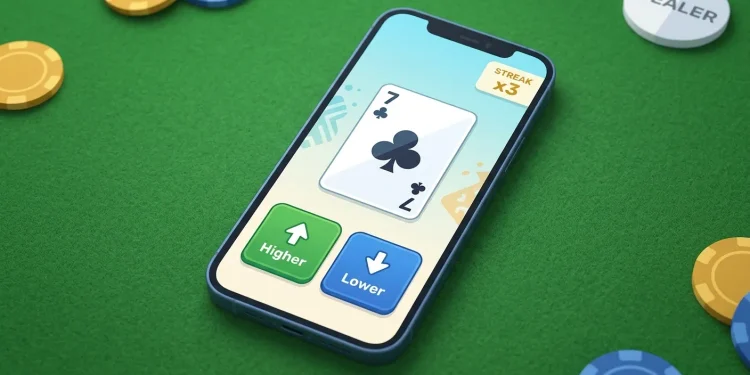
Hi Lo 2 takes about thirty seconds to learn: the screen shows you one card, and you predict whether the next card drawn will be higher or lower. Guess right and you win the round (and in most versions, build a streak multiplier); guess wrong and the round ends. That’s the entire core loop, which is exactly why the game has survived in so many forms — browser games, mobile apps, party card games, and casino versions all run on the same engine.
What trips up beginners isn’t the rules. It’s the details underneath them: how aces rank, what happens on a tie, when to bank a streak, and why the odds shift with every card shown. This guide covers all of it, step by step, so your first session of Hi Lo 2 makes sense from the opening card.
What Is Hi Lo 2, Exactly?
Hi Lo 2 is the higher-or-lower card prediction game — the “2” in the title generally signals an updated or second version of a platform’s original Hi-Lo game rather than a different game with new rules. Several unrelated games carry similar names, so a quick orientation helps:
- Casual/browser versions use play money or points. You predict cards, chase a high score or streak, and nothing of value is at stake.
- Casino-style versions (including crypto and sweepstakes platforms) attach real or real-ish wagers to the same predictions, usually with cash-out multipliers.
- Tabletop cousins like the HILO card game or Hi Lo Flip share the name but play completely differently — those are shedding/matching games, not prediction games.
This guide covers the prediction game, since that’s what “Hi Lo 2” refers to on game platforms. One honest caveat up front: because many sites publish their own version, button labels and extra features vary. The fundamentals below hold everywhere; the exact menu layout may not.
The Basic Rules of Hi Lo 2
Here’s a full round, from deal to result.
- A starting card is revealed. The game draws one card face-up from a standard 52-card deck (some versions use shortened decks — more on that later).
- You make a prediction. Choose Higher if you think the next card will outrank the current one, or Lower if you think it’ll rank beneath it. In versions with stakes, you set your bet before or alongside this choice.
- The next card is revealed. Right prediction: you win the round. Wrong: the round (and any streak) ends.
- Continue or stop. In streak-based versions, each correct call raises a multiplier, and you choose between banking what you’ve earned or risking it on another card.
Simple — but three rule details decide games, and beginners miss all three.
How Cards Rank (and the Ace Trap)
Most Hi Lo 2 versions rank cards from 2 at the bottom up to king, with suits irrelevant to the result. Aces are the trap: some games rank the ace as the highest card, while others — including a well-known Playtech version analyzed by the gambling-math site Wizard of Odds — treat aces as always low. Getting this wrong flips the correct call on every ace and every near-extreme card, so check the rules screen of your specific version before your first real prediction.
What Happens on a Tie
The next card sometimes matches the current one — another 8 lands on your 8. Versions handle this differently: some count a tie as a push (your bet carries on or returns), some count it as a loss, and some offer “Same” as its own separate bet with a big payout. Again, one glance at the info panel settles it.
Skipping a Card
Many modern versions include a Skip button that swaps out the current card without ending your round. It exists for the worst situation in the game: being dealt a middle card like a 7 or 8, where higher and lower are nearly coin flips. Skipping a mid-deck card for a fresh one is one of the few genuinely smart moves available, and new players tend to forget the button exists.
Card Odds: The Part Worth Actually Learning
Hi Lo 2 is a chance-based game, but it’s chance you can read. Every card on screen tells you the probability of each call, and good players simply follow the math.
The logic: with a 2 showing, almost every remaining card beats it, so Higher is close to a sure thing (and pays little). With a king showing, Lower is the near-lock. The closer the card sits to the middle of the deck, the closer the odds get to 50/50 — and the more a correct call pays.
| Current card | Smart call | Rough chance of winning* |
|---|---|---|
| 2 or 3 | Higher | Very high (85%+) |
| 4–6 | Higher | Moderate-to-good |
| 7–8 | Either / Skip | Near coin flip |
| 9–J | Lower | Moderate-to-good |
| Q or K | Lower | Very high (85%+) |
*Exact figures depend on deck size, ace ranking, and tie rules in your version — treat this as the shape of the odds, not gospel.
A widely cited rule of thumb captures it: below 7, bet higher; above 8, bet lower. It’s not a winning system (nothing is — see below), but it stops you from making mathematically backwards calls, which is where beginners lose most.
Two more probability facts worth internalizing:
- Each draw is independent in most digital versions. Online Hi Lo 2 games typically reshuffle between rounds, so five high cards in a row predict nothing about the sixth. Streak “patterns” are an illusion.
- Payouts mirror risk. Calling Higher on a 10 pays far more than calling Higher on a 3 precisely because it loses far more often. The multiplier isn’t a bonus; it’s the price of the risk.
A Sample Round, Played Out
Abstract rules stick better with a concrete run. Say you’re playing a free streak-based version:
- The opening card is a 4. Nine ranks beat it, two sit below. You call Higher. The next card is a jack. Correct — streak at 1, multiplier builds.
- The jack is now your current card. Only queen and king beat it, so you call Lower. A 6 lands. Correct — streak at 2.
- The 6 is mildly favorable for Higher, and you call it. A 7 appears. Correct, barely — streak at 3.
- Now the 7 is showing: the dead center of the deck. This is Skip territory. You swap it and get a queen. Easy Lower call… and a king lands. Wrong. Streak over.
That last card is the whole game in miniature. The queen made Lower overwhelmingly right, and it still lost — a good decision with a bad outcome. Hi Lo 2 rewards making the right call repeatedly, not winning any single round, and the sooner that clicks, the less tilted you’ll feel when strong calls fail.
Streaks, Multipliers, and Knowing When to Stop
Streak versions add the game’s one real strategic decision: cash out or continue. Every correct call multiplies your potential win, and every continuation risks the entire accumulated amount on one more card.
A few honest principles:
- Decide your exit before you start. “I bank after three correct calls” beats deciding in the moment, when the multiplier is whispering at you. Even platform guides for these games recommend setting a cash-out rule in advance and sticking to it.
- Longer streaks fail more often than intuition suggests. Even stringing together four 70% calls succeeds less than a quarter of the time. The multiplier grows because the odds shrink.
- Bank after lucky escapes. Survived a coin-flip call you shouldn’t have taken? That’s a gift, not momentum.
Free Versions vs. Real-Money Versions
This distinction matters enough to get its own section, because the same “Hi Lo 2” gameplay exists in two very different worlds.
Free and casual versions — browser games, score-chasing apps, point-based games — are pure entertainment. Play however you like; the worst outcome is a reset score.
Real-money versions are gambling, and everything changes:
- The house always holds an edge. Payouts are set slightly below the true odds of each call, so over time the game keeps a percentage no strategy can overcome. Any site promising a winning Hi Lo system is selling fiction.
- US legality varies by state. Online real-money casino play is legal in only a handful of states, while sweepstakes-model sites operate under different rules. What’s accessible and lawful depends on where you live, and rules change — check your state’s current regulations before depositing anything.
- Age limits apply — 18+ or 21+ depending on jurisdiction and platform.
- Set limits before you play. Fixed session budget, small bets relative to it, and no chasing losses. If gambling stops feeling like entertainment, the National Problem Gambling Helpline (1-800-GAMBLER) is free and confidential.
For learning the game, there’s no reason not to start free. Every mechanic — odds, streaks, skips — works identically without money attached.
Beginner Strategy: What Helps and What Doesn’t
Actually helps:
- Follow the odds on every card (the table above), especially on extremes
- Use Skip on 7s and 8s instead of guessing coin flips
- Pick a streak length in advance and bank there
- Check your version’s ace and tie rules before playing
- In money versions: small, consistent stakes and a hard session limit
Doesn’t help (despite what you’ll read elsewhere):
- Betting systems like Martingale (doubling after losses) — they don’t change the odds and can collapse a bankroll fast
- Reading “patterns” in previous cards — reshuffled digital decks have no memory
- Chasing a loss with a riskier call to “win it back” — the deck doesn’t know you’re down
The honest summary: skill in Hi Lo 2 means consistently taking the better side of each probability and managing when you stop. That’s real, it matters, and it’s also the ceiling. Nobody out-plays the math long-term.
Common Beginner Mistakes
A short list of the errors that end most first sessions early:
- Calling Higher on a 9 “because low cards keep coming.” The deck owes you nothing.
- Ignoring the ace rule, then losing a “sure” call when the ace ranked opposite to expectations.
- Riding every streak to zero. Without a cash-out rule, the multiplier always eventually eats the run.
- Treating near-50/50 cards as real decisions. On a 7, you’re flipping a coin; skip it or accept that it’s luck.
- Confusing the prediction game with same-named card games. If someone hands you 104 cards numbered -1 to 11, you’re playing a completely different HILO — ask for that rulebook instead.
The Takeaway
Hi Lo 2 earns its popularity honestly: one visible card, one decision, instant feedback. To play it well as a beginner, learn your version’s ace and tie rules first, let the on-screen odds pick your calls, skip the coin-flip middle cards, and decide before each run exactly when you’ll bank a streak. Start with a free version until those habits are automatic — and if you ever move to a real-money version, treat it as paid entertainment with a fixed budget, never as a way to earn. Master that mindset and you’ve mastered everything the game can be mastered at.
FAQ
Is Hi Lo 2 a game of skill or luck?
Mostly luck, with a thin layer of skill. Each card draw is random, but choosing the statistically better side, skipping bad cards, and cashing out streaks sensibly all affect results. No approach overcomes the built-in edge in money versions.
What’s the best strategy for Hi Lo 2?
Call Higher on low cards (roughly 6 and below), Lower on high cards (roughly 9 and up), skip or minimize middle cards, and bank streaks at a pre-set point. That’s the complete honest playbook.
Does the ace count as high or low?
It depends on the version — some rank aces highest, others always lowest. Check the rules or info screen of the specific Hi Lo 2 game you’re playing, because the answer changes correct play on several cards.
Can I win real money playing Hi Lo 2?
Real-money versions exist on casino and sweepstakes platforms, but availability and legality vary by US state, age limits apply, and the odds favor the house over time. Treat any wagering as entertainment spending, not income.
What happens if the next card is the same rank?
Platform-dependent: a push (bet returned or continued), a loss, or a win only if you placed a separate “Same” bet. It’s one of the three rules worth checking before your first round, alongside ace ranking and deck size.