


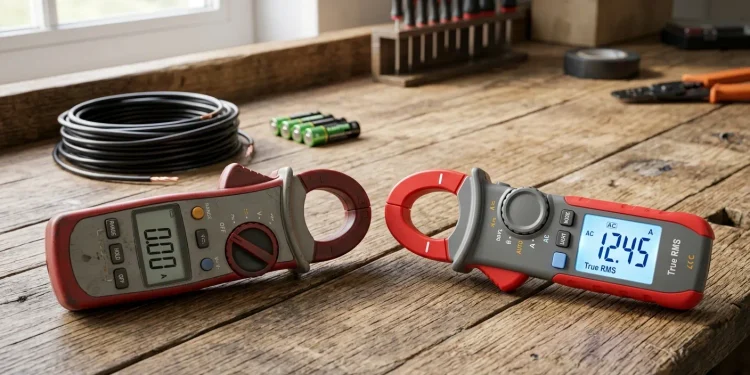
The Uni Trend 203 has been a quiet favorite for years for one reason: it’s one of the cheapest clamp meters that measures DC current, not just AC. When UNI-T replaced it with the UT203+, the headline specs barely moved — still 400 A, still 600 V, same 28 mm jaw. So is the “+” just marketing?
No, and the short version is this: the UT203+ adds True RMS measurement, a backlit display, non-contact voltage detection (NCV), capacitance measurement, and swaps the 9 V battery for two AAAs with aggressive power saving. The core ranges stayed put; the measurement quality and everyday usability are what changed. For most buyers in 2026 the decision is simple — the UT203+ is the one to get — but there are a couple of honest caveats worth knowing first, especially around accuracy class and safety ratings.
Quick Background: What the Uni Trend 203 Is
UNI-T (short for Uni Trend Technology) is a Chinese test-equipment maker whose meters dominate the budget tier on Amazon and at electronics distributors in the US. The UT203 family sits in its UT200 series of clamp meters — the tools that measure current by clamping around a wire instead of breaking the circuit.
What made the original UT203 interesting was DC current clamping. Cheap clamp meters typically read AC only, because AC sensing needs just a current transformer, while DC needs a Hall-effect sensor. DC clamping is exactly what you want for automotive diagnostics (parasitic battery drain), solar and RV systems, and trolling-motor or battery-bank work — all big use cases for US hobbyists. The UT203 delivered AC and DC up to 400 A at a price where competitors offered AC only, and the UT203+ keeps that same selling point.
UT203 vs UT203+ Side by Side
Here’s the comparison in one table, compiled from UNI-T’s series documentation and retail spec sheets. Double-check the listing you actually buy, since regional variants exist (there’s also a UT203R, essentially a UT203+ analogue sold in some markets).
| Spec / feature | UT203 (original) | UT203+ |
|---|---|---|
| AC current | 400 A | 400 A |
| DC current | 400 A | 400 A |
| AC/DC voltage | 600 V max | 600 V max |
| True RMS | No (average-responding) | Yes |
| Display | 3,999 counts, no backlight | 4,000 counts, larger digits, backlight |
| NCV (non-contact voltage) | No | Yes |
| Capacitance | Not measured | Up to 40 mF |
| Frequency range | Up to ~1 MHz | 10 Hz – 10 MHz |
| Resistance | Up to 40 MΩ | Up to 40 MΩ |
| Jaw opening | 28 mm | 28 mm |
| Power | 9 V (6F22) battery | 2 × 1.5 V AAA, auto power save |
| Extras | Data hold, REL, diode, continuity, duty cycle | Data hold, MAX/MIN, REL, zero mode, diode, continuity, auto power off |
| Weight / size | Similar form factor | 235 g, 215 × 63 × 36 mm |
Now the changes that actually matter, in order of practical impact.
The Changes That Matter
True RMS: The Real Upgrade
This is the one that justifies the “+.” The original UT203 is an average-responding meter: it assumes the AC waveform it’s measuring is a clean sine wave and scales accordingly. That assumption was fine in 1995. It’s routinely wrong in a modern US home or shop full of LED drivers, variable-speed motor drives, computer power supplies, and anything with a switching regulator — loads that draw distorted, non-sinusoidal current.
On those loads, an average-responding meter can read noticeably off — sometimes by double-digit percentages — while a True RMS meter computes the actual effective value of whatever waveform is present. The UT203+ measures true RMS in real time across varied voltage waveforms, which means its readings on real-world circuits are trustworthy in situations where the old model’s simply weren’t. If you ever measure current on anything electronic (and in 2026, what isn’t?), this change alone settles the comparison.
Backlight and a Bigger Display
Sounds trivial until you’re reading current draw in a crawl space, an attic, or under a dashboard. The original had no backlight at all. The UT203+ gets an LCD backlight plus a larger screen with bigger digits on its 37 × 25 mm display. Clamp meters get used in dark panels more than any other test tool; this fix was overdue.
NCV: A Safety Check You’ll Actually Use
The UT203+ adds non-contact voltage detection — hold the tip near a wire and it flags live AC without touching conductors. It’s not a substitute for proper verification, but as a first “is this thing live?” sanity check before opening a junction box, it’s genuinely useful and the old model didn’t have it.
Capacitance, for HVAC and Motor Work
The original UT203 measured no capacitance at all. The UT203+ measures up to 40 mF, which covers the motor-run and motor-start capacitors in US air-conditioning condensers, furnace blowers, and pool pumps. A weak run capacitor is one of the most common HVAC failures in American homes, so for DIYers this quietly turns the meter into a one-tool AC-season diagnostic kit. Note the modest ±(4%+5) accuracy — fine for “is this 45 µF cap actually reading 30,” not for precision electronics work.
Batteries and Power Management
The old meter ran on a 9 V block battery. The UT203+ uses two AAA cells and sips power — about 1.8 mA without backlight, under 11 µA in sleep, which UNI-T says stretches battery life to around 400 hours, with auto power-off after 15 idle minutes (defeatable). AAAs are cheaper, easier to find in a kitchen drawer, and the sleep mode means the meter you forgot to switch off in March still works in June.
Smaller Additions
The UT203+ also brings MAX/MIN recording, a zero mode for nulling the DC clamp’s offset before a measurement (important for accurate low-DC-current readings, like tracking a 50 mA parasitic drain), and extends frequency measurement to 10 MHz. The DC-zero habit matters: Hall sensors drift with temperature and the Earth’s magnetic field depending on clamp orientation, so zeroing right before a DC reading is the difference between a believable number and a guess — on either generation, but the dedicated mode makes it cleaner on the new one.
What Didn’t Change
Worth being clear-eyed about, because the “+” didn’t touch everything:
- Ranges. Still 400 A AC/DC and 600 V. If you need 600 A, that’s the UT204+ in the same series.
- Resolution class. 4,000 counts, same ballpark as before. This is not a 6,000- or 20,000-count meter.
- Jaw size. 28 mm either way — fine for residential conductors and automotive cables, tight for bundled feeders.
- No temperature probe. Neither version measures temperature per current retail specs; UNI-T reserves thermocouple input for other models in the lineup.
- Current accuracy. Spec sheets list the UT203+ current accuracy around ±(2%+5) to ±(2.5%+5) depending on the document — honest budget-tier numbers, not bench-grade. For “is this motor pulling 12 A or 18 A,” perfect. For calibration-adjacent work, look elsewhere.
The Fine Print US Buyers Should Read: Safety Categories
Here’s the detail store listings gloss over. The UT200+ series is designed to EN 61010 at CAT II 600 V / CAT III 300 V. Translated: it’s rated for 600 V on plug-connected loads and branch circuits (CAT II), but only 300 V in distribution-level environments like panels and feeders (CAT III).
For a US homeowner measuring at receptacles, appliances, car batteries, or solar charge controllers, that’s adequate. For an electrician working inside live 240 V service panels all day, a CAT III 600 V (or CAT IV) meter from the likes of Fluke, Klein, or UNI-T’s own higher lines is the responsible choice — the category rating reflects how much transient-surge energy the meter can safely absorb, and panel work is where big transients live. This isn’t a knock unique to UNI-T; it’s the trade-off of the sub-$50 tier generally. Treat the rating as a hard limit, not a suggestion, and when in doubt about working on live equipment, that’s a job for a licensed electrician anyway.
One more editor-level honesty note: some older UT203 listings floated higher category claims than the current series documentation supports. Go by what’s printed on the meter body and the included manual, not by marketplace copy.
So Who Should Buy Which?
Buy the UT203+ if:
- You’re choosing between the two today. It’s the current model, the True RMS and backlight are worth it, and the original is now mostly old stock. The UT203+ is positioned as the direct successor to the UT203 with true-RMS measurement as its headline improvement.
- You do automotive, RV, marine, or solar work and want cheap DC current clamping with believable numbers.
- You’re a homeowner who wants one meter for outlets, appliances, HVAC capacitors, and car batteries.
Keep your original UT203 if:
- It works, you mostly measure resistive loads and DC, and you know its average-responding limitation. The core ranges are identical; upgrading buys measurement quality and convenience, not new capacity.
Skip both and spend more if:
- You work in panels professionally (category rating), need better than ~2–2.5% current accuracy, need a jaw bigger than 28 mm, or want temperature — the UT204+ adds 600 A and more, and pro-tier meters add the safety headroom.
On price: US street pricing for the UT203+ typically lands in the budget clamp-meter bracket on Amazon and electronics distributors, but it fluctuates and varies by seller, so check current listings rather than trusting any number printed in an article.
The Takeaway
The Uni Trend 203’s “+” revision is a genuine generational update wearing an unassuming name. Nothing about the ranges changed — 400 A AC/DC, 600 V, 28 mm jaw — but True RMS fixed the old model’s biggest weakness on modern electronic loads, and the backlight, NCV, capacitance range, and AAA power system fixed its biggest daily annoyances. If you’re shopping now, buy the UT203+ and don’t overthink it; if you’re upgrading, the True RMS change alone is the justification; and if your work lives inside live distribution panels, respect the CAT III 300 V ceiling and shop a tier up. Next step: pull up the current UT203+ listing, confirm the spec sheet matches what’s described here, and check the printed category rating on the unit when it arrives.
FAQ
Is the UT203+ True RMS?
Yes. The UT203+ measures true RMS values of voltage and current waveforms in real time, while the original UT203 was average-responding — the single biggest difference between the two.
Does the UT203+ measure DC current?
Yes, up to 400 A with the clamp jaw, same as the original — that DC capability at a budget price is the main reason this model line is popular for automotive and solar work. Zero the clamp before each DC reading for accurate results.
What’s the difference between UT203+ and UT204+?
Same series, one tier apart: the UT204+ steps up to 600 A current ranges, a 6,000-count display, and extras like a 60 mF capacitance range and live/neutral wire testing. The UT203+ tops out at 400 A with a 4,000-count display.
Can I use the UT203+ inside my breaker panel?
Its rating is CAT II 600 V / CAT III 300 V, so it’s not rated for 480 V industrial distribution and is marginal territory for extensive live panel work. For receptacles, appliances, and branch circuits it’s fine; regular panel work calls for a CAT III 600 V meter and, for most homeowners, a licensed electrician.
What batteries does the UT203+ use?
Two 1.5 V AAA (R03) cells, replacing the original’s 9 V battery, with auto power-off and a sleep mode that UNI-T rates for roughly 400 hours of battery life.