


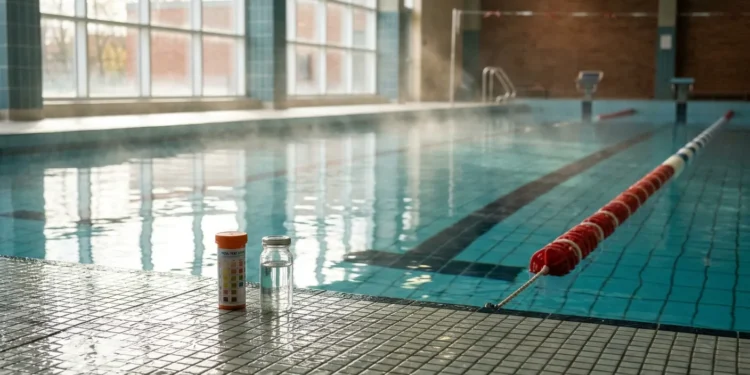
If your eyes burn, your throat scratches, or your stomach turns after a swim, the culprit usually isn’t too much chlorine. It’s the opposite problem. Chloramines form when chlorine, a common pool disinfectant, reacts with sweat, urine, and other human waste in the water — and those byproducts, not the disinfectant itself, cause most pool-related irritation. A separate problem explains the stomach bugs: some germs survive in treated water long enough to infect dozens of swimmers.
So the strong “chlorine smell” at a pool isn’t a sign of a clean, well-treated pool. It often signals the reverse. Here’s how to tell which chemicals in swimming pool water are causing your symptoms, when it’s an infection instead, and what you can check before you get in.
The Smell You Think Is Chlorine Isn’t Chlorine
A properly maintained pool barely smells at all. That sharp, eye-watering odor that hits you at an indoor pool comes from chloramines, also called combined chlorine.
Here’s the chemistry in plain terms. Chlorine does its job by attacking contaminants. When it binds to the nitrogen compounds in urine, sweat, skin cells, and body oils, it stops being an effective disinfectant and becomes an irritant instead. Tri- and di-chloramine can irritate the eyes and the respiratory tract, and they build up in both the water and the air around the pool.
Two consequences follow, and they’re worth separating:
- The water is now under-protected. Combined chlorine isn’t killing germs anymore. A pool reeking of “chlorine” may have very little usable disinfectant left.
- The air is now the problem. Chloramines can stay in the water or evaporate into the air above the pool, producing that pungent smell.
That second point is why swimmers sometimes get sick without swallowing a drop.
Indoor Pools Carry the Real Risk
Location changes everything. Chloramines aren’t considered a health hazard at outdoor pools. But in the enclosed space around a poorly maintained indoor pool, they can reach dangerous concentrations and trigger sudden eye and respiratory irritation in swimmers — and in anyone else in the room.
A documented US outbreak shows how fast this happens. In December 2006, a child was hospitalized in intensive care with chemical epiglottitis and laryngotracheobronchitis after swimming in an indoor motel pool in Nebraska. Investigators found 24 people reported illness, 20 of whom had entered the immediate pool area and four of whom had only been in the adjoining courtyard. Among those who entered the pool area, 70% developed symptoms within two hours.
The water chemistry explains it. The pool’s combined chlorine measured 4.2 ppm — at least eight times the acceptable level — alongside an extremely low pH of 3.95, conditions that favor heavy formation of trichloramine, and trichloramine causes more severe irritation and forms faster in low-pH water. The facility had an operator who wasn’t required to be certified and had no verifiable training.
That case was severe and unusual. Most people exposed to chloramines experience much milder symptoms. But it illustrates the pattern: bad maintenance plus poor ventilation plus an enclosed room.
Chemical Irritation vs. Actual Infection
This is where most readers get stuck, and it’s the practical question. Symptoms overlap, but timing and type usually separate them.
| Chemical irritation (chloramines) | Recreational water illness (germs) | |
|---|---|---|
| Typical onset | During the swim or within a couple of hours | Hours to days later — often 2 to 10 days for parasites |
| Common symptoms | Red, stinging eyes; cough; sore throat; wheezing; skin dryness or itch | Diarrhea, vomiting, stomach cramps; sometimes rash or ear pain |
| Who else is affected | Often several people in the same room at once, including non-swimmers | Scattered cases, sometimes across days or different sessions |
| Clue at the pool | Strong “chlorine” odor, stuffy indoor air | No reliable smell or visual clue at all |
The second column deserves its own section, because germs behave very differently from what most swimmers assume.
Some Germs Survive Chlorine for Days
Chlorine works fast on most pathogens. E. coli survives roughly a minute in a properly chlorinated pool, hepatitis A virus about 16 minutes, and the Giardia parasite about 45 minutes. Those numbers are reassuring.
Then there’s Cryptosporidium, which breaks the pattern completely. The CDC’s Waterborne Disease Prevention Branch states that Cryptosporidium can survive more than seven days in pool water at 1 ppm free chlorine, which is part of why it’s the leading cause of pool-linked outbreaks. One commonly cited figure puts survival in chlorine-treated water at around 10.6 days, and the illness can produce profuse watery diarrhea for up to three weeks — far longer than most stomach bugs.
A tough protective shell is why. Chlorine simply can’t get through it quickly, so no amount of normal treatment makes a contaminated pool safe in the usual timeframe. That’s the reason facilities post signs telling anyone who has had diarrhea in the past two weeks to stay out: a single person with diarrhea can contaminate an entire properly chlorinated pool or water park.
Crypto is also the hardest case to trace. Symptoms can start days after the swim, by which point most people blame lunch.
What You Can Actually Check Before Getting In
You don’t need to be a pool operator to do a thirty-second assessment. The CDC’s own advice for swimmers is more hands-on than most people realize.
1. Use your nose and eyes first. A healthy, well-run pool has little odor. A strong chemical smell, cloudy water, or a bottom drain you can’t see clearly are all reasons to pause.
2. Bring test strips. The CDC recommends using test strips — sold at hardware and pool supply stores — to verify pH sits between 7.2 and 7.8, with free chlorine at least 1 ppm in pools and at least 3 ppm in hot tubs, or bromine at least 3 ppm in pools and 4 ppm in hot tubs. A commonly cited working range for pools is 1–3 ppm free chlorine, with pH held at 7.2–7.8 so the chlorine can do its job efficiently, and hot tubs are usually run higher, around 2–4 ppm free chlorine or 4–6 ppm bromine.
The pH detail matters more than people think. Chlorine at the right concentration but the wrong pH is far less effective, which is how a pool can test “fine” for chlorine and still be unsafe.
3. Look up the inspection record. The CDC suggests checking a facility’s inspection records online before you go. Most US county health departments publish pool inspection results, and recurring violations tell you more than any single water test.
4. Judge indoor ventilation. If the air feels heavy and your eyes sting from the deck, before you’ve swum at all, that’s chloramine accumulation in the air. Leave the room.
How to Avoid Being Part of the Problem
Almost everything on this list exists because chloramines need body waste to form. Less waste in the water means less irritant and more working chlorine.
- Shower with soap before swimming. A quick rinse removes a meaningful share of the sweat, lotion, and residue that feed chloramine formation. It’s the single highest-impact habit, and almost nobody does it.
- Don’t swim with diarrhea — for two weeks after it stops. This is exactly why facilities post that rule, and one person ignoring it can contaminate a whole pool.
- Take hourly bathroom breaks, especially with kids. The CDC recommends hourly breaks so children can use the restroom and diapers can be checked and changed in a bathroom or changing area rather than poolside.
- Don’t swallow the water. Children are especially vulnerable because they’re much more likely to get water in their mouths.
- Rinse off afterward and change out of a wet suit promptly, which helps with skin and ear irritation.
When to See a Doctor
Most pool-related irritation fades within a few hours of getting into clean air. Some situations warrant medical attention rather than waiting it out:
- Any breathing difficulty, persistent wheezing, or a croupy cough after swimming — especially in a child, and especially after an indoor swim
- Diarrhea lasting more than a couple of days, or any diarrhea with blood, high fever, or signs of dehydration
- Symptoms in someone with a weakened immune system, who faces higher risk from Cryptosporidium, which can cause especially severe illness in that group
- Eye pain or vision changes that don’t resolve after rinsing with clean water
- Ear pain that persists, which may be an infection rather than trapped water
Tell the clinician you were swimming, and whether the pool was indoor or outdoor. That detail genuinely changes what they look for, and some water-related infections need specific testing rather than a general workup. Nothing here substitutes for an evaluation by a qualified healthcare professional.
It’s also worth reporting the problem. Public health guidance asks swimmers to report an unusually strong chlorine odor or any pool-related breathing or eye irritation to the pool operator, and to stay out of the water and away from that air in the meantime. If a facility is unresponsive, your county health department takes complaints.
The Takeaway
The chemicals in swimming pool water aren’t inherently the enemy — disinfection is what makes public swimming possible at all. What hurts people is the gap between a pool that’s treated and a pool that’s maintained: correct free chlorine, pH held in range, and real ventilation indoors.
Your practical next step costs about eight dollars. Keep a pack of test strips in your swim bag, check free chlorine and pH before anyone gets in, and treat a strong chemical smell at an indoor pool as a reason to walk out rather than a sign the place is clean. For any symptom that lingers more than a day or two, see a doctor and mention the swim.
FAQ
Why do my eyes get red after swimming?
Usually chloramines, not chlorine. They form when chlorine reacts with sweat, urine, and other waste in the water and are the chemical irritants responsible for stinging eyes.
Does a strong chlorine smell mean the pool is clean?
No, often the reverse. The odor comes from combined chlorine, meaning the disinfectant has already bound to contaminants and is no longer effectively killing germs.
Can I get sick from a pool without swallowing the water?
Yes. At indoor pools, chloramines that evaporate into enclosed air can cause sudden eye and respiratory irritation in swimmers and bystanders alike — in one outbreak, several affected people had never entered the pool area itself.
How long after swimming do symptoms usually appear?
Chemical irritation often starts during the swim or within about two hours. Infections take longer, sometimes days — Cryptosporidium in particular can surface well after you’ve forgotten the swim.
Are saltwater pools free of these problems?
No. Saltwater pools generate chlorine from salt rather than adding it directly, so chloramines still form from the same body waste. The maintenance rules are the same.