


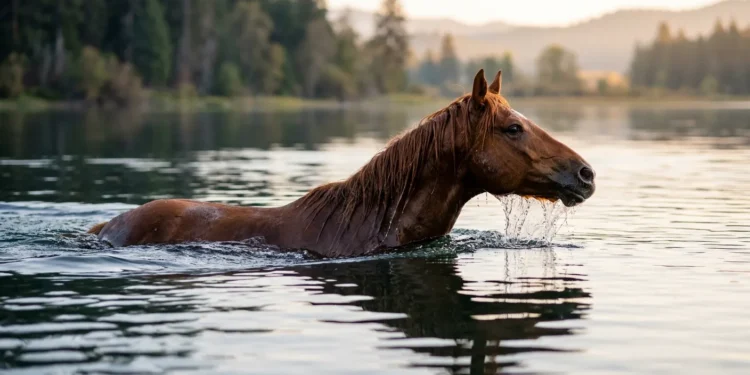
Yes — horses can swim, and they don’t need to be taught. Drop a healthy horse into water deep enough that its hooves leave the bottom and instinct takes over: the legs keep moving in a motion close to a trot, the big barrel of a body floats, and the horse paddles forward with its nose and eyes clear of the surface. It’s innate, not learned.
That’s the short answer. The longer one matters more if you’re thinking about riding into a lake this summer, because “can swim” and “should swim” aren’t the same sentence. Swimming is brutally hard work for a horse, their breathing leaves no margin for error, and a horse that’s never been deeper than its fetlocks can panic in water its body would otherwise handle fine. Here’s how it actually works.
How a Horse Swims
Watch from the shore and you mostly see a head and a wake. Watch from underwater and the picture is clearer: the horse looks like it’s trotting through the water, legs cycling in a rhythmic paddle. Horses swim much the way dogs do, using paddle-like motions with their legs — the movement is close enough to their natural land gait that no adaptation is required.
Three things make it work:
Lung capacity. A horse’s lungs are enormous relative to most animals, and all that air functions as a built-in float. The size of a horse’s lungs directly aids their competency in the water, keeping the chest buoyant so the body sits high enough for the head to stay clear.
Leg length and power. Long, strong legs mean each kick moves a lot of water. Horses use those legs to propel their bodies forward efficiently rather than just thrashing to stay up.
Natural body buoyancy. The barrel-shaped torso floats well on its own. Combine that with the lungs and a horse doesn’t have to fight to stay at the surface — it mostly has to steer.
What you won’t see is anything resembling human technique. There’s no stroke, no breathing rhythm, no efficiency to improve. It’s the same gait the horse already knows, performed in a medium that resists it far more than air does.
Why the Head Stays Up (and Why That’s Non-Negotiable)
Here’s the detail most articles skip, and it’s the single most important safety fact in this whole topic: horses cannot hold their breath the way humans can. If a horse’s head goes under, the drowning risk is immediate and serious, not a matter of seconds to spare.
You’ll find pages online claiming horses hold their breath for up to five minutes while swimming. Treat that claim with heavy skepticism — it contradicts how equine respiration actually works and appears to be copied from source to source without verification. A horse swims with its nostrils above the waterline because it has to, and anything that pushes the head down — a rider’s weight in the wrong place, a wave, a panicked lunge, tack that catches — turns a manageable situation into an emergency fast.
This single physiological fact drives nearly every safety rule further down.
Do Horses Swim Naturally, or Is It Learned?
Swimming is an inborn instinct, not a trained skill. When a horse loses its footing in deep water, it begins moving its limbs in that walking-like motion and stays afloat without any prior experience. Wild horses have used this to cross rivers after fresh grazing, to escape predators, and to follow the herd across water.
But there’s a distinction worth holding onto, because conflating the two is where people get into trouble: physical ability to swim is not the same as being comfortable in water. Almost every healthy horse has the first. Plenty don’t have the second.
Some horses walk straight into a pond and start pawing and splashing. Others won’t put a hoof in a puddle. A horse that’s never gone deeper than its ankles may panic in open water even though its body would cope perfectly well. The instinct fires once the horse is swimming; getting it to that point is the part that depends on temperament and exposure.
How Long Can a Horse Swim?
This is where published sources genuinely disagree, and you deserve an honest account rather than a confident number.
| Source type | Stated duration | Context |
|---|---|---|
| Equestrian press and vet-leaning sources | 5–10 minutes per session | Treated as strenuous exercise with a hard cap |
| Some equine blogs | 20–30 minutes | Usually describing fit, conditioned horses |
| Observed reality | Varies widely | Older or unfit horses may manage only a couple of minutes |
The conservative figures come with the better reasoning behind them. Swimming is hard work and tires horses quickly, with typical guidance landing at roughly five to ten minutes per session. One frequently cited comparison puts a three-minute swim at roughly the equivalent of a three-mile gallop on land. Another frames a ten-minute swim as comparable to cantering several miles.
Treat those comparisons as rules of thumb rather than measured physiology — they’re repeated across equestrian publications but aren’t precise clinical figures. The useful part is the order of magnitude: minutes in water equal miles on land. A less athletic or older horse may barely keep itself afloat and manage only a couple of minutes before it’s in trouble.
The practical rule, regardless of which number you believe: plan around the low end, not the high end. A tired horse in deep water is one of the more dangerous situations in all of riding, and horses don’t signal exhaustion as clearly in water as they do on land.
How Fast and How Far?
Roughly walking pace. Published estimates for horse swimming speed cluster around 1 to 2 mph, with some sources citing figures near 1.6 km/h as an average. Distance estimates run to a few hundred meters for a typical adult horse before needing rest, with figures around 800 meters appearing in some accounts for experienced horses in good conditions.
All of these numbers are soft. They depend on fitness, water temperature, current, and whether the horse is carrying a rider. Strong current or rough water cuts every figure substantially.
A Real American Example: The Chincoteague Pony Swim
If you want proof that horses swim as a matter of routine rather than a stunt, Virginia’s Eastern Shore provides it annually.
Every July, “Saltwater Cowboys” from the Chincoteague Volunteer Fire Company round up the feral ponies living on Assateague Island and herd them across the Assateague Channel to Chincoteague Island. The tradition began in 1925 as a fundraiser for the fire company, and it now draws crowds in the tens of thousands.
The details are instructive for anyone wondering what a real horse swim looks like:
- It’s short. The crossing typically takes around five minutes, with some years reported closer to 18 minutes depending on conditions.
- Timing is everything. The swim is scheduled for slack tide, when the channel has little or no current — which has meant start times as early as 6:47 a.m. in some years.
- It’s not all swimming. Part of the channel is shallow enough for the ponies to walk on the marsh bottom, so the actual swimming portion is shorter than the crossing suggests.
- The weakest animals are exempted. Foals too small to safely make the crossing are trucked across the causeway with their mothers instead.
- It’s supervised. Riders on horseback accompany the herd the entire way.
Short duration, calm water, no current, supervision, and the vulnerable individuals excluded. That’s not a coincidence — it’s the template for doing this safely, worked out over a century of practice. The event also draws scrutiny from some animal-welfare advocates concerned about round-up stress, which is a reminder that even well-managed horse swims involve real strain on the animal. (Details reported by National Geographic’s coverage of the pony swim.)
Can You Ride a Horse While It Swims?
Technically yes. In practice, it’s an activity for experienced riders in controlled water, and it changes the risk profile considerably.
When a horse starts swimming beneath you, several things happen at once. The horse floats lower, so you’ll be in water to roughly your waist or chest while mounted. The saddle becomes slippery and unstable. Your weight sits where it can push the horse’s forehand down — the exact direction you don’t want, given the breathing issue above. And the horse’s paddling legs are moving directly below, which is a genuine hazard if you come off and end up underneath.
Common guidance from experienced riders:
- Many prefer to dismount and swim alongside, holding a lead or a handful of mane rather than staying in the saddle.
- Shift your weight back and keep your hands forward so you’re not pulling the horse’s head down.
- Avoid heavy tack. Wet leather and metal add weight and catch on things.
- Never tie yourself to the horse in any way.
- Wear a life vest yourself, especially in open water.
If you’ve never done it, go with someone who has, in water they know, on a horse that’s swum before. This isn’t a thing to improvise on a trail ride.
Safety Rules Worth Following
Horses drown. Not often, but it happens, and almost always in preventable circumstances. These are the precautions that matter most:
- Know the bottom and the depth. Unseen drop-offs, soft mud, and submerged debris cause more problems than deep water itself. A horse that gets a leg stuck panics, and a panicking horse in water is dangerous to everyone.
- Avoid current. Rivers, tides, and surf can carry a swimming horse far faster than it can correct. The pony swim’s slack-tide scheduling exists for exactly this reason.
- Keep sessions short. Minutes, not tens of minutes, especially the first several times. Stop while the horse still has energy in reserve rather than when it looks tired.
- Enter gradually. Let the horse wade, stand, and get comfortable with water moving around its legs before anything approaches swimming depth. Rushing this is how you create a horse that’s afraid of water for life.
- Have an exit planned. Know where the horse can get its feet back under it and climb out. A bank that’s too steep or too muddy to exit is a trap.
- Check the water itself. Blue-green algae blooms are toxic to horses, and water quality in ponds and lakes varies by season and region. Local agriculture extension offices and state environmental agencies publish advisories.
- Never force it. A horse that refuses to enter is telling you something. Forcing the issue with a horse that’s already frightened is the most reliable way to produce a dangerous situation.
One more: cold water is harder on horses than it looks, and a long swim in cold conditions carries real risk of chilling, especially for older horses. Dry and walk them afterward.
When Swimming Is Used as Therapy
Equine swimming pools and underwater treadmills have become standard tools at rehabilitation facilities. The appeal is straightforward: water supports the horse’s weight, so the cardiovascular and muscular work happens without the concussive loading that land exercise puts on legs and joints. Equine swimming pools are used both for building fitness and for rehabilitation following certain injuries.
That said, this belongs firmly in the “consult a professional” category. Swimming isn’t appropriate for every injury — some conditions are made worse by the extended, unsupported range of motion in water, and the exertion level is high enough to matter for horses with cardiac or respiratory issues. Any therapeutic swimming program should be designed with your veterinarian, at a facility equipped for it, not improvised at a local pond. This article is general information, not veterinary advice. (Horse & Hound’s overview of swimming horses covers the equestrian-press perspective on benefits and risks.)
The Bottom Line
Can horses swim? Yes, instinctively and reasonably well — big lungs keep them buoyant, long legs push them forward, and the paddling motion is close enough to a trot that no learning is needed. What they can’t do is swim for long, swim hard against current, or recover from getting their head underwater.
So the honest answer isn’t just “yes.” It’s “yes, briefly, in calm water, with their nose up, and with someone paying close attention.” If you want to try it with your own horse, start with wading in water you know, build from there over multiple sessions, and talk to your vet first if there’s any question about the horse’s fitness or soundness. The instinct is already there. Everything else is your job.
FAQ
Do horses enjoy swimming?
Some clearly do and will splash and paw at water voluntarily. Others want nothing to do with it, and won’t even cross a puddle. Enjoyment varies by individual temperament and early exposure — the ability is universal, the enthusiasm isn’t.
Can horses hold their breath underwater?
Not in any useful way. Horses can’t hold their breath the way people can, which is why a submerged head is an emergency rather than an inconvenience. Claims of five-minute breath-holding circulate online but conflict with how equine breathing works.
How long can a horse swim before getting tired?
Conservative guidance says about five to ten minutes, and some sources put a three-minute swim on par with a three-mile gallop. Unfit or older horses may manage only a couple of minutes. Plan short and stop early.
Can all horses swim?
Virtually all healthy horses can, since it’s instinctive rather than learned. Horses with injuries, respiratory problems, or significant unfitness are a different matter, and a horse that’s terrified of water may not swim safely even though it physically could.
Is it safe to ride a horse while it’s swimming?
It can be, with an experienced rider, a horse that’s done it before, and calm, known water. The risks are a slippery saddle, the rider’s weight pushing the horse’s head toward the water, and paddling hooves below the surface. Many riders choose to dismount and swim alongside instead.