


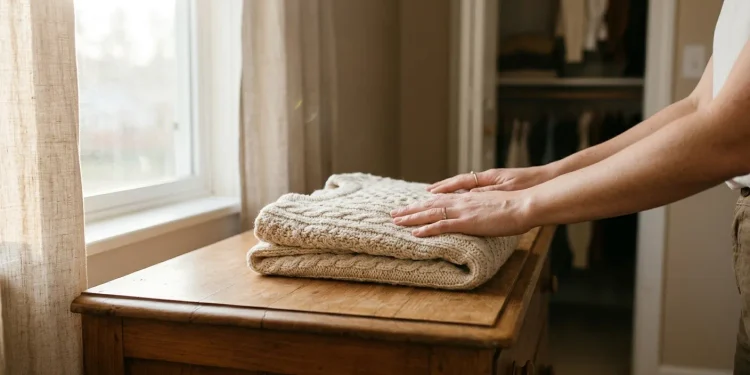
Fashion meditation is the practice of turning getting dressed into a short, deliberate mindfulness exercise instead of a rushed scramble. You pause before opening the closet, choose clothes based on how you want to feel and function that day, then pay actual attention to the physical act of dressing — the weight of the fabric, the texture against your skin, the small motions of buttoning and fastening. It takes three to five minutes and requires nothing you don’t already own.
The appeal is practical, not mystical. Dressing is something you already do every single morning, so attaching a mindfulness practice to it costs no extra slot in your schedule. This guide covers how to do it step by step, what the psychology research genuinely supports (and where it’s shakier than wellness blogs suggest), and how to keep the habit from quietly turning into another source of pressure.
What Fashion Meditation Actually Is
Strip away the branding and you’ll find two familiar ideas stitched together.
The first is mindfulness applied to a routine task. This isn’t new or exotic. Formal mindfulness training often introduces the concept through mindful eating — famously, spending several minutes with a single raisin, noticing its texture, smell, and taste. The point of that exercise isn’t the raisin. It’s demonstrating that any ordinary action becomes a meditation when you bring full attention to it. Getting dressed qualifies just as well as eating.
The second is intentional clothing choice — selecting what you wear based on the day ahead and the state you want to be in, rather than defaulting to whatever’s on top of the pile. One useful framing from practitioners: mindful fashion isn’t about dressing for attention, it’s about dressing with intention.
Put together, fashion meditation is a short anchored practice with two halves: a brief decision phase and a brief sensory phase. That’s the whole thing. Anyone describing it as more complicated is probably selling something.
What It Isn’t
Clearing up three common mix-ups saves a lot of confusion:
- It isn’t sustainable fashion. The two overlap but answer different questions. Mindful fashion focuses on how your clothing makes you feel; sustainable fashion is about how your clothing impacts the planet. A fashion meditation practice can lead you toward buying less, but that’s a side effect, not the definition.
- It isn’t a capsule wardrobe. You don’t need to own less to practice this. You can do it with an overstuffed closet.
- It isn’t a religious practice, though mindfulness has deep roots across contemplative traditions. You can practice it as a purely secular attention exercise, and most people do.
What the Research Does and Doesn’t Support
Here’s where this guide parts ways with most articles on the topic. Wellness writing loves to attach confident scientific claims to soft practices. The honest picture is more mixed, and knowing the difference protects you from disappointment.
Reasonably well-supported: mindfulness practice in general. The National Center for Complementary and Integrative Health notes that research suggests mindfulness-based approaches can help with stress and anxiety, though effects vary by person and the quality of evidence differs across conditions. A short daily attention practice is a low-risk thing to try.
Interesting but contested: the idea that specific clothes change your cognition. A well-known 2012 study by Hajo Adam and Adam Galinsky coined the term “enclothed cognition,” reporting that participants wearing a coat described as a doctor’s coat performed better on attention tasks than those wearing the same coat described as a painter’s. It’s a genuinely fascinating finding and it gets cited constantly. It’s also been subject to replication difficulties, like many priming studies from that era of psychology. Treat it as a suggestive idea, not a proven mechanism.
Mostly folk wisdom: color psychology in clothing. The claim that blue calms you and red energizes you is widely repeated and intuitively appealing, but the research on color and emotion is inconsistent and heavily culture-dependent. If wearing a particular color makes you feel a certain way, that’s real and worth using. Just don’t expect it to work like a pharmaceutical.
What you can reasonably expect, then, is modest and still worthwhile: a calmer start, fewer decisions made in a panic, and a few minutes of attention training. If someone promises more than that, be skeptical.
The Real Problem It Solves: Morning Decision Fatigue
Before the how-to, it’s worth naming why this lands for so many people.
The typical American weekday morning involves a compressed sequence of choices made under time pressure, and clothing is one of the most repeated. The pattern is familiar enough to be a cliché: most of us get up in panic mode and frantically hunt for something to wear while the minutes tick away, often ending with a pile of rejected “maybes” on the bed.
That scramble does two things. It burns decision-making energy before the workday starts, and it sets a frantic tone that tends to persist. Fashion meditation works less because of anything magical about clothes and more because it replaces a recurring stress spike with a brief, structured moment of calm.
Which also explains why the preparation step below matters as much as the mindfulness itself.
The Step-by-Step Morning Practice
Here’s a sequence that fits a real weekday. Total time: about five minutes, with an optional two minutes the night before.
Step 0: Prepare the Night Before (2 minutes)
Skip this and the morning version gets much harder. You can’t be mindful while searching for a missing shoe. The standard advice from stylists holds up: lay out your clothing the night before, and make sure anything that needs ironing is done and anything that needs locating has been found.
People who dress calmly in the morning are almost always the ones who know where everything in their closet is. You don’t need a minimalist wardrobe for that — just a rough system and a reset once a week.
Step 1: Pause Before You Open the Closet (30 seconds)
Stand still. Three slow breaths. Resist reaching for anything yet.
This single pause is what separates the practice from ordinary dressing. It creates a gap between the impulse to grab something and the act of grabbing it, which is the mechanism behind most mindfulness exercises.
Step 2: Ask Two Questions (1 minute)
Not ten questions. Two:
- What does today actually require? Three client meetings, a long commute, standing on your feet, a dinner you’ll go to straight from work. Practical demands first.
- How do I want to feel in it? Grounded, sharp, comfortable, unbothered, a little bold.
That’s the full decision phase. Keeping it to two questions prevents the practice from sliding into a twenty-minute styling session, which is the most common way it fails.
Step 3: Choose, and Then Stop Choosing (1 minute)
Pick the outfit. Then close the closet.
This boundary is deliberate. The goal is one decision made with attention, not an extended audition. If you find yourself on outfit number four, the practice has become its own stress source — see the troubleshooting section below.
Step 4: Dress With Attention (2–3 minutes)
This is the meditation proper, and it’s the part people skip. Instead of dressing on autopilot while mentally drafting emails, bring your attention to the physical experience: the weight and texture of each garment, the temperature of the fabric against your skin, the specific motions of fastening buttons, pulling up socks, threading a belt.
When your mind wanders to your inbox — and it will, repeatedly — notice it and come back to the sensation. That return is the exercise. People often assume a wandering mind means they’re doing it wrong. It’s the opposite: noticing the wander and returning is the entire rep.
Step 5: Set One Intention, Then Move On (15 seconds)
As you finish, name one thing for the day. “I’ll stay patient in the 10 o’clock meeting.” “I’ll leave the office on time.” Keep it concrete and behavioral rather than a vague affirmation about your worth — specific intentions are easier to act on and easier to notice when you follow through.
Then leave it. No journaling required, no mirror ritual.
A Realistic Timeline of What to Expect
Setting expectations honestly prevents the usual week-two abandonment.
| Timeframe | What typically happens |
|---|---|
| Days 1–3 | Feels awkward and slightly silly. You’ll forget Step 1 at least once. |
| Week 1 | The night-before prep starts saving real time. The sensory part still feels forced. |
| Weeks 2–4 | The pause becomes automatic. Morning outfit stress noticeably drops. |
| Month 2+ | You start noticing which clothes you reach for and which you never do — useful wardrobe information you got for free. |
Nothing dramatic happens at any stage. That’s normal. The benefit is cumulative and mostly shows up as an absence — less friction, less rushing — which is easy to overlook precisely because it’s quiet.
Adapting It to Your Actual Life
The five-minute version assumes a reasonably typical morning. Most mornings aren’t typical.
If you have 90 seconds, not five minutes. Keep Step 1 and Step 4 only. Three breaths, then dress with attention to texture and motion. The decision phase can be skipped entirely if you prepped the night before.
If you work from home. The practice arguably matters more, not less, because there’s no external dress code creating a boundary. Choosing deliberately between “work clothes” and “rest clothes” gives your brain a signal that the day has started. Comfortable is fine; unconsidered is what causes the drift.
If you wear a uniform or scrubs. The decision phase mostly disappears, which makes the sensory phase the whole practice. Many people in uniformed work find this version cleaner — there’s nothing to deliberate, just the act of putting it on with attention.
If you’re getting kids out the door. Do your own version in 90 seconds while they’re occupied, or attach it to a different repeated task entirely — making coffee, the first two minutes of the commute. The specific task matters far less than having a consistent anchor.
If mornings are genuinely impossible. Move it. An evening changing ritual after work serves the same function in reverse, marking the end of the workday rather than the start.
When the Practice Backfires
Four failure modes come up often enough to name, because the standard articles on this topic never mention them.
It becomes perfectionism. If your three-minute practice stretches to twenty and ends with four discarded outfits, mindfulness has been replaced by rumination. The fix is a hard rule: one outfit, decided, closet closed. Discomfort with that rule is useful information about what’s actually going on.
It becomes shopping. A frequent and convenient side effect, especially when the idea arrives via brand content: you conclude you need new “intentional” pieces. You don’t. Practice with what you own for at least a month before buying anything. If the practice only works with a new wardrobe, it isn’t the practice working.
It turns into self-criticism. Standing in front of a mirror with heightened attention can amplify body criticism rather than calm it. If that’s happening consistently, shift your focus from how things look to how they feel — fabric, temperature, fit — and skip the full-length mirror until the habit settles. If the thoughts are persistent and distressing, that’s worth raising with a therapist or counselor rather than troubleshooting with a wardrobe routine.
It gets performed instead of practiced. A practice photographed for social media is a different activity than a practice done privately. Both can be fine, but they don’t produce the same benefit, and confusing them is easy when the whole aesthetic is so photogenic.
A broader caution: fashion meditation is a wellness habit, not treatment. If you’re dealing with significant anxiety, depression, or body image concerns, this is a supplement at most. Talk to a licensed mental health professional about those.
A Quick Self-Check After Two Weeks
Four questions worth asking once the habit has had a fair trial:
- Am I getting dressed with less friction than before?
- Has the practice stayed roughly the same length, or has it crept longer?
- Have I bought anything because of it? (Not automatically bad — just worth noticing.)
- Do I actually feel different on days I do it versus days I skip it?
Honest answers here tell you whether to keep it, trim it, or drop it. There’s no obligation to continue a practice that isn’t doing anything for you, and plenty of people find the night-before prep delivers most of the benefit on its own.
The Takeaway
Fashion meditation works because it’s small and attached to something you already do. Three breaths before the closet, two questions about the day, one outfit chosen and committed to, and a few minutes of genuine attention to the physical act of dressing. No new purchases, no app, no 5 a.m. wake-up.
Start tonight with the easiest piece: lay out tomorrow’s clothes and put everything you’ll need in one place. Then tomorrow morning, before you open the closet, just stop for three breaths. That’s the entire first rep. Build the rest from there once it stops feeling strange.
FAQ
How long does fashion meditation take?
About three to five minutes, plus roughly two minutes of prep the night before. A compressed version works in 90 seconds if you’ve prepped. If it’s regularly running past ten minutes, it’s drifted into outfit deliberation rather than mindfulness.
Do I need a specific kind of wardrobe to practice it?
No. It works with whatever you own, including a messy or oversized closet. Any suggestion that you need to buy “mindful” clothing first is marketing, not method.
Is there real science behind clothing affecting how you think?
The research is suggestive but not settled. The “enclothed cognition” concept from a 2012 study is the most-cited source, and studies of that type have faced replication challenges. Mindfulness practice itself has a stronger evidence base than the clothing-specific claims.
What if I can’t stop my mind from wandering while I get dressed?
That’s expected and not a failure. Noticing that your attention drifted and bringing it back to the physical sensation is the actual exercise, not an interruption of it.
Can I practice it if I wear the same thing every day?
Yes, and it’s arguably simpler. With no outfit decision to make, the practice is purely the sensory half — dressing slowly and with attention, which is the part most people skip anyway.